Let’s talk about order of operations in the classroom. When we introduce a new topic to our students, we could…
- …start by explaining that topic forthrightly.
- After that explanation, we could let students explore independently.
Or, we could
- …start by letting students explore.
- After their exploration, we could explain the topic ourselves.
These two approaches — explore first and explain first — have ardent proponents, and debates on the topic quickly become heated. Let’s see what a recent study tells us about these approaches.
Broken Syntax
A research team, led by Dr. Marci DeCaro, worked with almost 1,200 first-year engineering students studying the Python programming language. In these experiments, students learned about various Python errors: syntax errors, name errors, and type errors.
- As you’d expect, some of the students “explored first.” That is, they were given a simple Python program to play with, and asked to break it. After 12 minutes, they then heard a lecture about those three error types — including examples and instructions on fixing them.
- The other students heard the “explanation first.” After the lecture on three types of errors, they tried to break the simple Python program.
In other words: all students explored, and all students heard the explanation. The key difference: which happened first?
To deepen this study’s analysis, DeCaro added one more variable.
- Some students learned about all three error types simultaneously — either “explore first” or “explain first.” DeCaro calls this the “complex” lesson.
- Other students learned about one error at a time — again, either “explore first” or “explain first.” Unsurprisingly, this lesson falls under the heading “simple.”
Team DeCaro wanted to know: did students learn more when they explored first, or when the professor explained first? And: did the complexity of the lesson matter?
The Numbers
To answer that first question — “which approach led to more learning?” — DeCaro asked students both factual questions and conceptual questions about Python coding errors. The results in the “complex” lesson were clear:
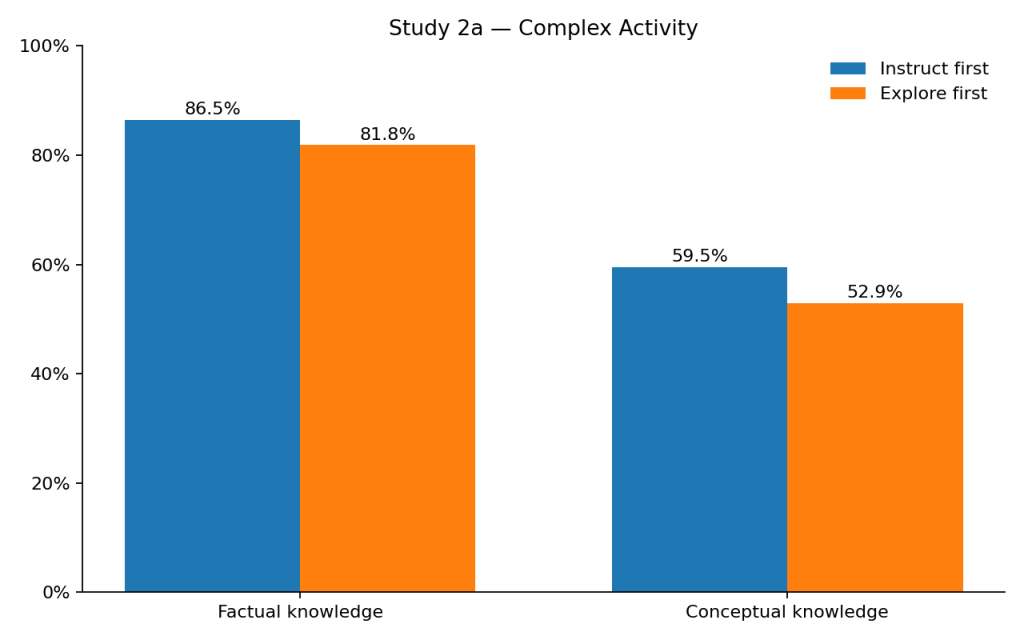
When students explored three different errors at the same time, they learned both facts and concepts better in the “explain first” lesson. These differences aren’t large (Cohen’s d = 0.27 for factual learning and 0.23 for conceptual learning). But all the students I know would rather get an 88 than an 82 on a quiz.
The results after the “simple” lesson are also straightforward:
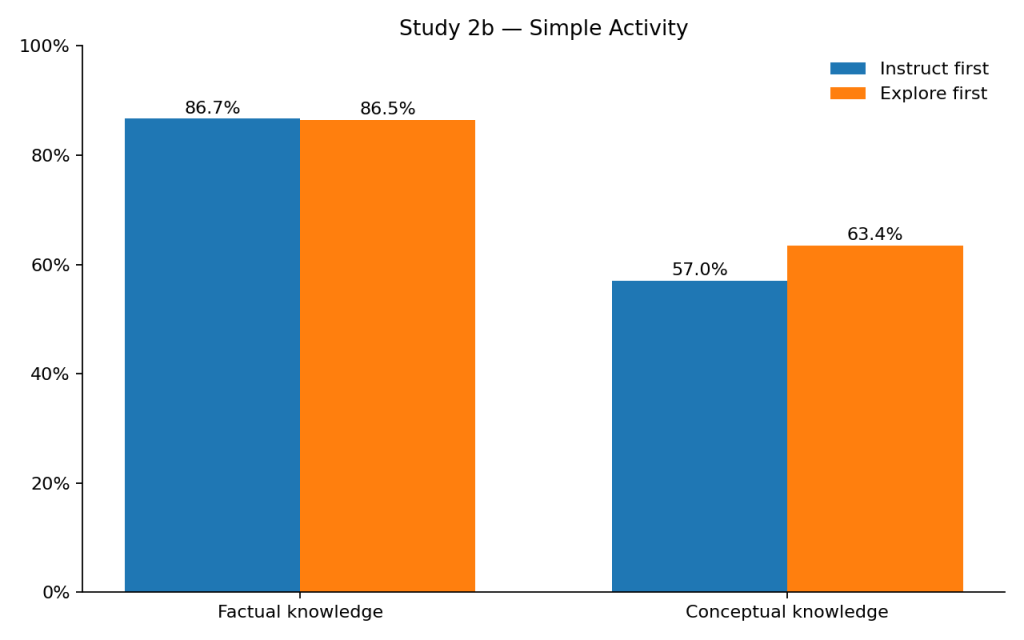
When studying one kind of error at a time, students learned factual information equally well in both lessons. An “explore-first” approach helped them learn concepts. (Cohen’s d here is 0.23: not large, but not nothing.)
Beyond the Numbers
These results allow a quick summary:
When teaching a complex lesson — with multiple interacting concepts — “explain first” works better.
When teaching a simpler lesson — with only one main idea — “explore first” helps students learn concepts. And both approaches work equally well for factual knowledge.
I think that plausible summary benefits from two important additions.
First: this study measured students’ learning at the end of the lesson. Researchers have repeatedly shown that short-term performance isn’t a reliable indicator of long-term learning. In other words: if we were to retest the students two weeks later, we might get meaningfully different results.
Second: the quick summary above dodges an essential question: “how do we decide if a lesson is simple or complex?” DeCaro’s study answers that question by focusing on the number of error categories explored: 1 vs. 3. How should we manage that calculation for our own students?
I don’t have a rigid answer to that question, but I want to offer this guideline:
Students typically find new material more complex than we think they will. When in doubt, I should assume that my lesson is complex.
As you recall, the participants in this study were engineering majors, and they were studying a topic relevant to their academic and professional success. In other words: they’ve had enough academic success to be accepted to college. They’ve chosen a demanding course of study. They’re as likely as anyone to value Python programming.
And despite all their strengths, they learned less when they explored three topics first than they did when the professor’s explanation preceded their exploration.
New Frameworks
Frequently on this blog — as recently as two weeks ago — I have written about desirable difficulties. Teachers want learning to be the right kind of hard. If we get the balance right, students will struggle a bit in the short term, but learn more in the long term. For instance: interleaving makes practice problems harder, and students who do interleaved problem sets typically learn material better.
This study suggests that — unless the lesson is unambiguously “simple” — an “explore first” approach might be the wrong kind of hard. I myself typically focus on working-memory load as an essential consideration. When my instructional design results in too much WM strain, students will struggle to make sense of — and struggle to learn — the ideas at the core of my lesson.
In other words: while the practice that students do should be desirably difficult, the initial instruction should be bracingly clear.
DeCaro’s study potentially offers a way to calm the heated debates. Under the right circumstances, an explore-first approach can work well; when students meet several new ideas or procedures, an explain-first lesson probably keeps difficulty at a desirable level.
DeCaro, M. S., Bego, C. R., Thompson, A. K., & Patrick, R. J. (2026). Considering Cognitive Load When Exploring Before Instruction: The Potential Role of Element Interactivity. Educational Psychology Review, 38(1), 127.
Soderstrom, N. C., & Bjork, R. A. (2015). Learning versus performance: An integrative review. Perspectives on Psychological Science, 10(2), 176-199.