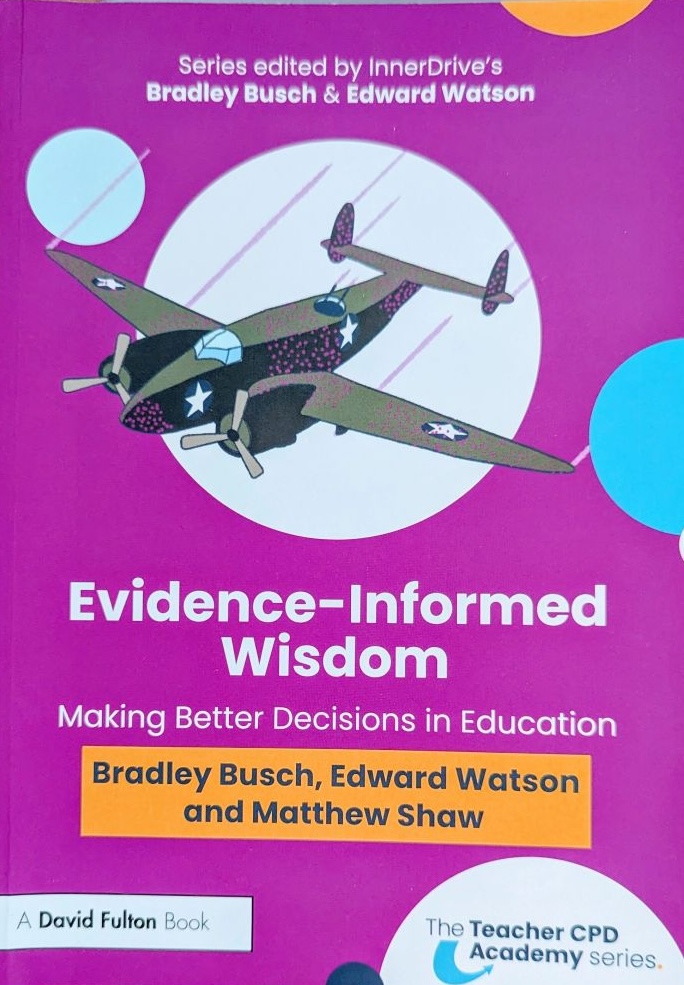
We spend a lot of class time watching otherwise sharp students reason their way into confident, wrong conclusions — mistaking a vivid story for evidence, an average for a person, a feeling of certainty for being right (and we all know we are not immune to this). A colony of cobras, a parked airplane, and a jar of jam turn out to be surprisingly good correctives — the kind of examples you think you already know, until the book gets to the part you didn’t. Bradley Busch, Edward Watson, and Matthew Shaw’s Evidence-Informed Wisdom: Making Better Decisions in Education is, essentially, a book about that gap — the space between knowing what a study found and knowing what to do with it.
The authors, from the UK consultancy InnerDrive, build their case on a small logic puzzle: is Anna a teenager? Being over twelve is necessary but not sufficient. Being under twenty is necessary but not sufficient. You need both.
Good teaching decisions, they argue, need research, experience, and context all at once, and each one alone is a trap. The clearest illustration is the 2018 BMJ study they open with: a randomized trial that found parachutes made no difference to survival when jumping from a plane. The punchline, buried in the methods, is that the plane was parked on the ground and jumpers stepped off from two feet up. It’s a real, peer-reviewed paper, deployed almost as satire, and it sets the tone for a book that trusts its readers to hold two ideas at once: evidence matters, and evidence divorced from context can be technically true and completely useless.
The rest of the book runs the same play on experience and expertise. Veteran teachers really do read a classroom differently than novices, a phenomenon researchers call professional vision. But expertise has a strange failure mode: chess masters who can reconstruct three-quarters of a real game board collapse to no advantage at all once the pieces are scrambled into a position that could never occur in play. It turns out to be a library of familiar patterns, not a general power, and it without the match there could be crickets. The best story here belongs to Lt. Gilbert Daniels, who measured four thousand Air Force pilots in the 1950s and found not one of them average on all ten dimensions that mattered. The fix wasn’t a better average cockpit. It was adjustable seats.
Each chapter opens with the same small graphic, a simple icon for the necessary/not-sufficient idea, and that pairing is the book’s real design strength: every idea gets a page, a picture, and nothing more, which keeps sprawling research succinct enough to actually use on a Tuesday. That clarity matters, because the book refuses to let “evidence-informed” collapse into a synonym for “safe.” A chapter on lethal mutations shows how retrieval practice curdles into a rigid five-question quiz, and how cognitive load theory gets read as “minimize load” when under-load is its own problem. Even the epilogue, built around Chesterton’s Fence, argues that the wisest response to a compelling data point is sometimes to leave things alone. Their example: the Pepsi Challenge, and the century-old Coke recipe that never actually needed fixing. If you are unfamiliar with these wonderful examples definitely take the time to peruse this book.
This book is aimed at K-12 teachers and the school leaders trying to get them to change, and it earns that audience with material you can actually use for you or your students. It will also be enjoyed by anyone who can’t scroll past the Instagram post that makes you feel like you already understood a thing, until it shows you exactly where you didn’t. Evidence-Informed Wisdom runs that trick throughout, and it’s honest enough to admit, at the very end, that it can’t tell you when to stop. In some sense this is also a fun but serious collection of important mental puzzles that will reframe your thinking.