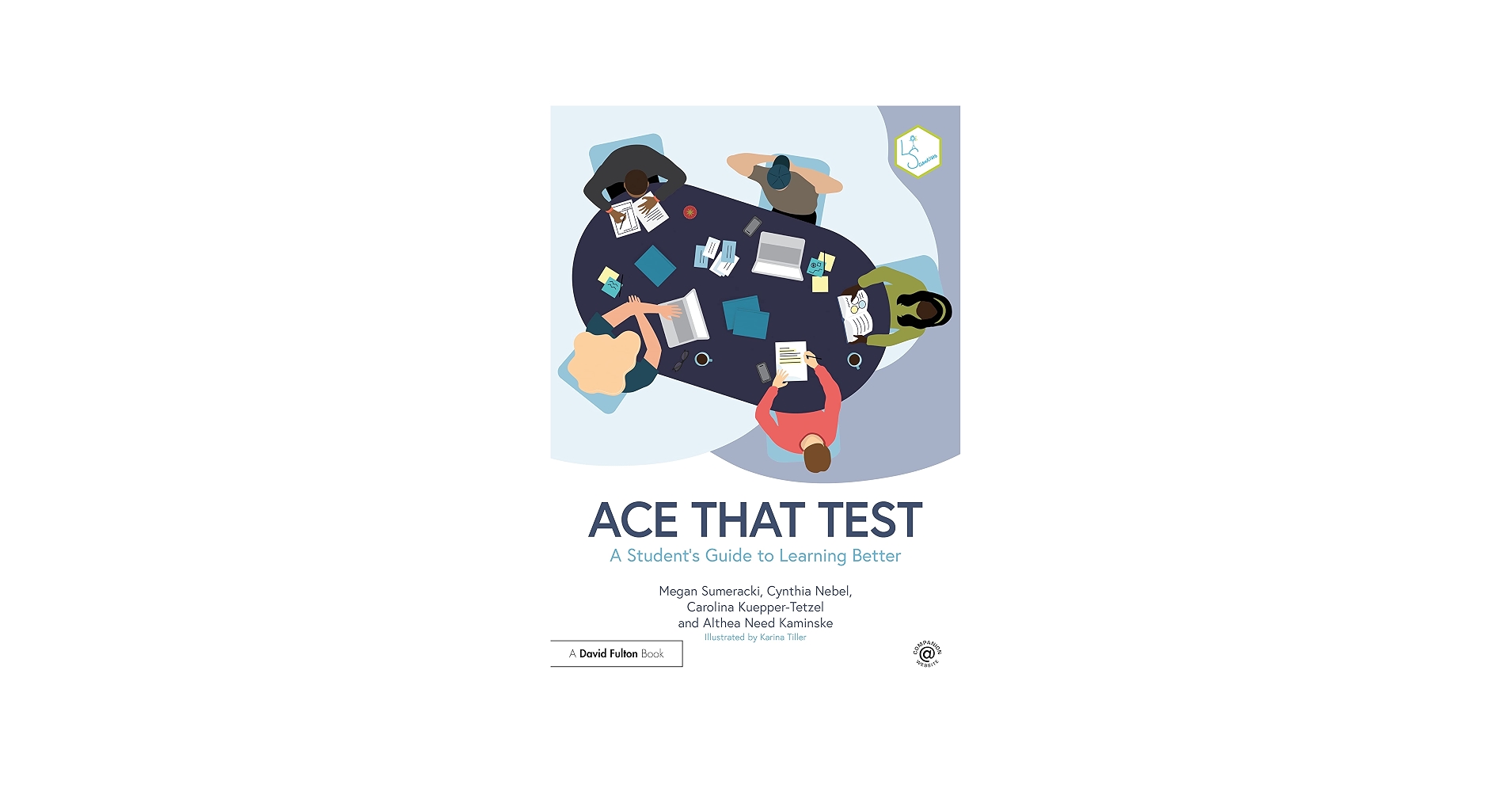
Every semester, a student catches us after class or during office hours with some version of the same complaint: I read the chapter, I did the homework, I even made flashcards, and I still bombed the quiz. What went wrong? The diagnosis is rarely laziness; it’s that “studying” has become a catchall word covering activities with wildly different payoffs, and nobody ever taught these students which ones actually work. Ace That Test, by Megan Sumeracki, Cynthia Nebel, Carolina Kuepper-Tetzel, and Althea Need Kaminske — the four cognitive psychologists behind the Learning Scientists project — is built to close exactly that gap.
The book’s organizing move is a comparison the authors return to often: studying advice should work like medicine, not like a recipe. There’s no single correct dose, only principles drawn from decades of cognitive-science research on memory and learning, which each reader adjusts to their own situation; that promise holds up chapter to chapter. Take the chapter on multitasking, which doesn’t just call task-switching inefficient and move on. Yeykelis, Cummings, and Reeves found that people jump between tasks roughly every nineteen seconds when working across multiple screens. A burst of anticipatory pleasure fires right before they switch away from the boring task toward something more entertaining — but not the other way around. That’s a useful reframe for anyone who has told a student to just try harder to focus: the pull isn’t a failure of willpower, it’s a small reward already built into the switch itself.
The chapter on metacognition may do the most for a reader’s actual grades are the ones on retrieval and spacing. In one study the authors describe, students who reread a passage four times predicted they’d do well on a test a week later, then fell short of their own prediction. Students who instead read the passage once and then practiced retrieving it from memory twice predicted they’d do worse, and beat both their own forecast and the rereaders’ actual scores. Why does the harder path outperform the easier one? Because the comfortable feeling of “this is going well” is itself a poor signal, and studying that feels difficult and a little discouraging is often the studying that’s working.
Spacing teaches a related lesson, and Rawson and Kintsch’s research makes the trade-off vivid. Students who cram immediately before a test do better on that test than students who spread the same material across two study sessions a week apart; but two days later, the spaced group retains almost twice as much. Cramming isn’t worthless, just narrowly useful — good for tomorrow’s quiz, not much else.
What sets the book apart from the usual study-hacks roundup is the chapter on trusting the evidence in the first place. It spends real time on the difference between a correlation and a cause. The example is almost too silly to forget: ice cream consumption and sunburns rise together at the beach, though obviously neither causes the other. Behind that levity is a genuinely rigorous standard: the authors say a finding only earns a place in the book once it has held up in basic laboratory studies, then in more realistic materials, then in real classrooms. A reader will probably still have that ice cream image a year later, long after forgetting the methodology lesson it illustrates.
The book’s design helps too. Chapters are short and generously illustrated. Each one closes with a boxed “chapter takeaways” summary and a QR code linking to supplementary material — enough that a student can get the gist in one sitting and come back later for the deeper version. A running cast of student characters gives the research somewhere to land instead of floating as abstraction. One nearly gives up on flashcards, convinced the difficulty means it isn’t working.
The closing chapter, on self-efficacy, is the one I keep holding in mind. A teacher emails half his students an encouraging note after their first exam, citing their progress, other students’ successes, and his own confidence in them, and that group does noticeably better on the next exam. The finding is a fitting place for the book to end: all the retrieval practice and spacing in the world only helps a student who believes the effort is worth it.
This is a book written for students, not the adults who teach them, and it says so plainly. Readers here will mostly be doing something on someone else’s behalf: pointing an advisee to it rather than annotating it themselves. That’s exactly why I’d keep a copy around. I wish it had existed when I was the confused sophomore rereading a chapter for the fourth time, certain that one more pass would finally make it stick. The real argument underneath all fifteen tight chapters isn’t which technique to use, but how little you can trust your own sense of how well you’re learning in the moment. Believing the discomfort is progress, not failure, is what makes any of the rest of the advice usable at all.