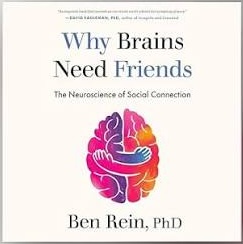
“I know I should get out more. I need more social connections.” We hear some version of this all the time, in office hours, in hallways, in conversations with colleagues caught between work and technology. Most of us don’t need to be told that friends are good for us. The message is everywhere, from public health warnings about a loneliness epidemic to every wellness article we have ever skimmed. And yet, as Ben Rein points out early in Why Brains Need Friends: The Neuroscience of Social Connection, knowing it hasn’t changed us much. So he isn’t here to convince you that friendship is good. His argument is that we have been handed the conclusion without the mechanism; if we could see what connection does inside the brain, we might finally take it as seriously as sleep or exercise.
Rein is well placed to make that case. He is a Stanford neuroscientist, and some of the book’s best moments come straight from the lab, told by someone who still seems a little amazed by the data. My favorite is an accident. Joshua Crapser and his colleagues were studying stroke recovery in mice, not loneliness, when they noticed something odd in their results: mice that lived alone were left with more brain damage from the exact same stroke. Rein follows that surprise through cortisol and chronic inflammation, and by the time he arrives at the human data (in one large cohort, people with weak social ties were 50 percent more likely to die during the study), loneliness has started to look like what Rein says it is: a health risk in roughly the same league as obesity.
The second half is where I found the book most useful, because it turns the question around. If connection is this good for us, why do we keep declining the invitation? If you have ever let a call go to voicemail or kept your earbuds in on the train, Rein has an uncomfortable answer: your brain is a poor forecaster of social moments. Commuters in Nicholas Epley’s studies were sure strangers would brush them off; not one did. Asked to rate themselves on twenty everyday skills, people claimed to be above average at nearly everything, hygiene included, except holding a conversation. And when the conversation ends, Erica Boothby’s “liking gap” research suggests we walk away underestimating how much the other person liked us. Our withdrawal, Rein suggests, is less a preference than a miscalculation, and a miscalculation can be corrected.
He also has a knack for findings that quietly rearrange ordinary life. A standard dose of acetaminophen dulls our empathy not only for other people’s pain but for their good news. Rein mentions people who have reached for painkillers on purpose during a breakup. His chapter on online life opens with a stranger who posted a harsh TikTok video about him, then apologized profusely the moment he left a comment, as if he had only just become a real person. That exchange grew into the “virtual disengagement hypothesis,” which he and his student Maria Tavares proposed in 2024: screens fail to engage the brain’s empathy systems. Educators will want to linger in this chapter, especially over the Norwegian schools where smartphone bans were followed by a 29 percent drop in girls’ psychological symptoms and a 43 percent drop in bullying.
The book is written for general readers, and it reads easily. A handful of simple figures carry real weight (a graph of how much time we spend alone across the lifespan is sobering), each chapter closes with a short list of key takeaways, and Rein includes an extroversion questionnaire and a “social journal” for tracking which interactions actually leave us better off. Teachers and counselors will find plenty to use. Academic readers should know that the citations live on the author’s website rather than in the book; that keeps the pages clean but makes checking a claim more work.
In the closing pages Rein sets the lab work aside and says what he has come to believe: that love and connection may be the reason we’re here at all. He grounds this in a conversation with his eighty-seven-year-old grandmother, who has outlived nearly everyone she grew up with and told him she is still alive because of her love for him and his mother. I came away thinking the book’s deepest lesson isn’t really about oxytocin or the nucleus accumbens. It’s that the brain keeps quietly underestimating other people, and that this is a correctable error. That is reassuring, because the stranger on the train probably wants to talk more than we think. It is also a little uncomfortable, because it means the distance was mostly ours to close.
On that note, I’m off to the gym with a friend who wears AirPods while we work out. I may bring the audio book for him.