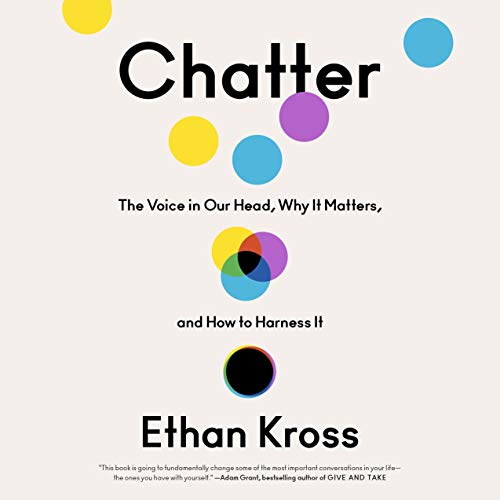


 The founder and director of the Emotional and Self-Control Laboratory at the University of Michigan, Ethan Kross has been a leading voice in a field that is helping us understand the workings of the conscious mind and how understanding its mechanisms can enable us to live happier and more fulfilled lives. While much of our daily life is spent mind wandering and listening to our inner voice, we do not always think about the dynamic ways it is directly linked to our daily experiences. The chatter of our internal voice can seem to be a distracting and destructive cacophony of internal thought. In Chatter: The Voice in Our Head, Why it Matters, and How to Harness It, Kross synthesizes his and others’ research in the field concentrating on this inner voice from a scientific perspective, a book sorely needed to help us understand and take advantage of this all too human condition.
The rich narratives of research, mini-bios, and the wonderings and personal experiences of the author give the reader the sense that they are sitting down and having an intriguing dinner conversation with Kross. We hear about chatter through various anecdotes that we can all relate to and then how individuals overcome the debilitating chatter and move toward a constructive internal discourse. Among these great relatable narratives are a distracted baseball player, a neuroscientist who experienced a stroke losing her inner voice, and an anxious applicant for a job at the NSA among many others. While still theoretically laden and packed tight with empirical research, this book reads much more like a friendly storytelling – always a refreshing approach to science.
This is not just a book explaining what the inner voice is, it is a book about our conversations with ourselves and those around us. How are those conversations affecting that inner voice, and how is our inner voice affecting those conversations? It also demonstrates the intrinsic connectivity between chatter and the environment suggesting ways we can improve our ability to manage chatter by changing our surroundings and some of our basic daily habits. These little nudges to our daily practice are summarized at the end of the book in a set of concrete tools but the real joys of these are in the narrative support the author gives throughout the text.
Beyond the rich, relatable, and entertaining stories, this is also an exceptional example of translational research bringing together neuroscience, psychology, psychobiology, and sociology in a truly interdisciplinary translational endeavor. The artful interweaving of the book’s main ideas across conceptual levels demonstrates the importance of this type of interdisciplinary work.
But this book also hit me in a personal way enriching my own conversations. I could not help but send an uncontrolled stream of texts to friends as I read the book. It captured the essence of many conversations about self-improvement, but it reframes the discussion, grounding it in research but also asking us to consider experimenting in our own lives. It was immediately accessible and curiosity-inducing to family, friends, and colleagues. And there is something authentic for every reader from advice for the psychotherapist to how best to support yourself and your friends. Our internal voice is so visible and yet our ability to reflect on it is limited. Kross gives us some window into those relationships we can improve with ourselves and those around us and it clearly sends the message that chatter is socially embedded and not an individual endeavor.
This short book could easily be read in an afternoon of cerebral escapism tickling your curiosity about your own mind and filling your stores of knowledge with fun and personal narratives easily shared with friends. But it’s a must-read for anyone listening to their inner crickets.