
classroom advice – Page 11 – Education & Teacher Conferences Skip to main content
Design Thinking: How Does It Work In The Classroom?
Andrew Watson
Andrew Watson

Design thinking invites students to approach learning with an engineer’s perspective.

Students begin with a problem, and think their way towards several possible solutions. Each design thinking framework includes its own particulars, but all include variations of these steps:

deliberately explore the problem,

brainstorm several possible solutions,

create those solutions,

repeat these steps as necessary (with healthy doses of metacognition).

Here, for instance, is a 1-pager from Harvard’s Graduate School of Education that summarizes key design-thinking ideas and protocols.

To be confident that this approach has merit, we should ask ourselves two hard questions:

First: do students who learn design thinking apply it in new circumstances? If not, then the method might help students solve a specific problem — but not help them think differently about problems in general.

Second: when students apply design thinking to novel problems, do they learn more than others who don’t? If not, then this new way of thinking doesn’t seem to have made much of a difference.

So: how might we answer these tough questions?

Researchers at Stanford’s School of Education wanted to give it a try

The Research Plan

A large research team worked with 6th graders in a California public school. They had students practice two distinct design thinking systems.

One group practiced a system that urged them to seek out corrective feedback. That is: they got in the habit of looking for constructive criticism.

A second group practiced a different design-thinking system that emphasized creating several different prototype models before deciding on which one to pursue.

Helpfully, the study design insured that students learned and used these 2 systems in different classes.

Math class (2 weeks)

Social Studies (1 week)

Science (1 week)

A week later, students took a test gave them the chance to apply those skills.

However — and this is the key point — the test didn’t resemble any of the previous design thinking work that they had done. For this reason, the test let researchers answer this question:

“Do students who practice design thinking for a full month spontaneously apply those strategies when facing new, not-obviously-related problems?”

And, given how well they did on this test, it let them answer a second question:

“Do these design thinking strategies help students solve problems more effectively?”

That is: this study design let researchers answer the two hard questions we asked ourselves at the beginning of this post.

Two Answers

This study, I suspect, will be something of a Rorschach test for people who look at its conclusions.

Skeptics — and, by the way, I myself am often in the “skeptic” category — may focus on the most straightforward finding: “there was no stand-alone effect of treatment.”

In other words: the training didn’t have a statistically measurable effect.

Optimists, however, might well have a different take.

To explore their results in greater detail, Chin & Co. analyzed data for the students based on their prior academic accomplishment.

For students in the high-achieving group, and the middle-achieving group, the design thinking training had no statistically measurable effect.

However, for those in the low-achieving group, it certainly did.

An optimist’s summary might go like this.

“Mid- and high-achieving students are ALREADY doing what design thinking teaches. That is, those student ALREADY seek out constructive feedback, and try different models before they decide on one.

The design-thinking training helped low-achieving students behave more like their mid- and high-achieving peers.

That’s great!”

If, in fact, a design thinking curriculum can help some students develop the good learning habits that other students already have, that is in fact great news.

The best way to use design thinking will clearly depend on your own school’s culture and demographics. This study gives us some hope that — used the right way with the right students — it can help students learn.

“But I Study Much Better With My Music On”
Andrew Watson
Andrew Watson

You have, no doubt, heard of the “Mozart Effect.”

The short version is: “listening to Mozart makes you smarter!” (Translation: “Parents: run right out and by Mozart recordings for your children!”)

The longer version is: “in one study, children who listened to Mozart before they took a spatial reasoning test did better than those who didn’t. The effect lasted, at most, fifteen minutes.”

That initial study turned into several books, and several extravagant claims. In 1998, the governor of Georgia wanted the state budget to buy every child a classical music recording.

Plausible Extrapolation?

If listening to Mozart before a spatial reasoning test improves performance, then … just maybe … listening to music while I do my schoolwork will help me think better.

I know LOTS of teenagers who insist that this is true. Whenever I talk about brain research at schools, high-schoolers assure me quite passionately that they learn more with their music playing.

That’s a plausible claim. Let’s research it.

Perham and Currie tested this claim quite simply. They had adults take a reading comprehension test adapted from the SAT. Over headphones, they heard either…

…music they chose because they liked it (Frank Ocean, Katy Perry),

…music they didn’t like (thrash metal),

…music that didn’t have lyrics, or

…silence

What Perham and Currie find?

Quite clearly, these learners did their best thinking in silence.

More specifically, when they answered reading comprehension questions in silence, they averaged 61%. Listening to music without lyrics, they averaged a 55%. Music with lyrics — either likable-Katy Perry or disliked-thrash metal — led to a 38% average.

The drop from a 61% to a 38% should get everyone’s attention.

Here’s a straightforward summary for our students.

Would you like to increase your reading comprehension 20%?

TURN OFF THE MUSIC and read in silence.

Asking the Right (Narrow) Question

To sum up:

Perham and Currie’s study strongly suggests that listening to music with lyrics interferes with reading comprehension.

This study strongly suggests that listening to music during a task interferes with students’ creativity.

But, this study suggests that listening to upbeat music before a task increases creativity.

And, this study might — or might not — suggest that students who join band classes in high school improve in their ability to process language sounds … which might (or might not) have beneficial academic effects.

In other words: to understand the relationship between music and learning, we need to ask narrow, precise questions.

When students say “I study better with music because, Mozart Effect,” we can say:

a) we’ve got good research showing that’s not true,

and

b) we can’t extrapolate from very tentative Mozart findings to your homework.

One final point deserves emphasis.

I understand the desire to say: “students should study music because it helps them do this other thing better.”

I’d rather say: “everyone should make music, because it connects us to our humanity and to each other.”

Mozart or Frank Ocean or Thrash Metal. Bring it on…

Overcoming Potential Perils of Online Learning
Andrew Watson
Andrew Watson

Online learning offers many tempting — almost irresistable — possibilities. Almost anyone can study almost anything from almost anywhere.

What’s not to love?

A tough-minded response to that optimistic question might be:

“Yes, anyone can study anything, but will they learn it?”

More precisely: “will they learn it roughly as well as they do in person?”

If the answer to that question is “no,” then it doesn’t really matter that they undertook all that study.

Rachael Blasiman and her team wanted to know if common at-home distractions interfere with online learning.

So: can I learn online while…

…watching a nature documentary?

…texting a friend?

…folding laundry?

…playing a video game?

…watching The Princess Bride?

Helpful Study, Helpful Answers

To answer this important and practical question, Blasiman’s team first had students watch an online lecture undistracted. They took a test on that lecture, to see how much they typically learn online with undivided attention.

Team Blasiman then had students watch 2 more online lectures, each one with a distractor present.

Some students had a casual conversation while watching. Others played a simple video game. And, yes, others watched a fencing scene from Princess Bride.

Did these distractions influence their ability to learn?

On average, these distractions lowered test scores by 25%.

That is: undistracted students averaged an 87% on post-video quizzes. Distracted students averaged a 62%.

Conversation and The Princess Bride were most distracting (they lowered scores by ~30%). The nature video was least distracting — but still lowered scores by 15%.

In case you’re wondering: men and women were equally muddled by these distractions.

Teaching Implications

In this case, knowledge may well help us win the battle.

Blasiman & Co. sensibly recommend that teachers share this study with their students, to emphasize the importance of working in a distraction-free environment.

And, they encourage students to make concrete plans to create — and to work in — those environments.

(This post, on “implementation intentions,” offers highly effective ways to encourage students to do so.)

I also think it’s helpful to think about this study in reverse. The BAD news is that distractions clearly hinder learning.

The GOOD news: in a distraction-free environment, students can indeed start to learn a good deal of information.

(Researchers didn’t measure how much they remembered a week or a month later, so we don’t know for sure. But: we’ve got confidence they had some initial success in encoding information.)

In other words: online classes might not be a panacea. But, under the right conditions, they might indeed benefit students who would not otherwise have an opportunity to learn.


I’ve just learned that both of Dr. Blasiman’s co-authors on this study were undergraduates at the time they did the work. That’s quite unusual in research world, and very admirable! [6-11-19]

Handshakes at the Door: Hype, or Helpful?
Andrew Watson
Andrew Watson

You’ve seen the adorable videos. Teachers have special handshakes they use to greet students as they enter the classroom. For instance:

https://www.youtube.com/watch?v=I0jgcyfC2r8

I can’t help but smile when I see a video like that. What could set a better mood to start an academic day?

Of course, I’d smile even more if we had research to show such a strategy might be effective.

Well, let me shake your hand this morning with good news: we do have such research.

Beyond Cute Videos

All teachers recognize the problem. In the hallway between classes, students revel in their freedom. We want them to settle down and get working.

How can we best make that vital tonal transition happen?

A large research team investigated a proactive strategy they call “positive greetings at the door.” The strategy focuses on two steps:

First: greeting each student positively at the door: “Good morning, Dan — great hat!”

Second: offering “precorretive” reminders: “We’re starting with our flashcards, so be sure to take them out right away.”

The researchers trained five teachers (in sixth, seventh, and eighth grades) in these strategies.

Happily, the researchers did a great job to ensure the validity of their research. For instance, the control group was not merely five other teachers going about “business as usual.” Instead, this control group was also trained by school administrators in other classroom management strategies.

In other words: all ten teachers got training. Five practiced “positive greetings”; five practiced “attention control.” Overall, more than 200 students were in these classrooms.

The Envelope Please

What effect did all these greetings and all these proactive reminders have?

Researchers video-taped classes before and after these trainings.

For the control group, little changed. Time on task was in the mid-to-high 50%, while disruptive behaviors took place about 15% of the time.

For the positive greeting group, researchers saw big changes.

Time on task went from the high-50% to more than 80% of the time.

Disruptive behaviors fell from ~15% to less than 5% of the time.

All that from positive greetings.

Will This Strategy Work for Each of Us?

Researchers chose classrooms that were both racially and economically diverse.

At the same time, they asked principals to nominate classes that had seen higher-than-average levels of disruption.

That is: if your class is already well behaved, you might not see much of a change. (Of course, if your class is already well behaved, you don’t really need much of a change.)

Another important point: the video above shows a teacher demonstrating verve and drama. If that level of energy doesn’t match your style, don’t worry. You DO NOT need a big performance to make the strategy work.

You can keep it simple and quiet.

Stand at the door. Greet students by name. Perhaps shake their hands. Give them proactive reminders of how to start well.

The volume level doesn’t matter. Your daily personal reconnection with each student does the work.

Constructivism: In The Brain, In The Classroom
Andrew Watson
Andrew Watson

In this helpfully provocative post, Mike Hobbiss argues that we often misapply the theory of constructivism.

For Hobbiss, the theory makes perfect sense when describing learning. However, he  worries that constructivism is unlikely to be helpful as a theory of pedagogy.

As he argues, drawing on extensive neuroscientific research, we can help students construct their own understandings by creating multiple, partial, and overlapping mental schema.

That kind of “constructivism as learning” might not be best fostered by “constructivism as teaching.”

Hobbiss offers this potentially controversial argument in measured and thoughtful tones. Even if you disagree with him — perhaps especially if you disagree with him — his ideas merit a careful read.

But Does It Work In The Classroom? (A Hint: YES!)
Andrew Watson
Andrew Watson

Teachers who follow brain research have probably heard of “interleaving.”

This teaching strategy encourages us to mix up different kinds of practice problems, rather than sort them tidily into distinct bunches.

Imagine, for instance, that your math curriculum includes these four units:

A: graphing lines

B: calculating the area of circles

C: simplifying expressions

D: solving inequalities

I might be tempted to have have my students review graphing one night. The next night, they would focus on circles. The next, they would simplify expressions. And so forth. (Researchers call this “blocking.”)

Or, I could have them practice all four skills each night. (“Interleaving.”)

So, does blocking or interleaving help students learn better?

One Useful (but Incomplete) Answer

We have “known” the answer to this question for a long time.

The answer is: interleaving. By a lot.

When students interleave while practicing, they learn information more durably.

However, the verb “know” is in quotation marks above because we “know” that answer in a very particular setting.

The best-known research of interleaving took place in a college psychology lab.

Students learned formulas to calculate the volumes of irregular solids. Those who interleaved practice did better on a quiz two weeks later than those who blocked.

To be clear: this is a great study. (I always show it when I talk about interleaving with teachers. The graphs get gasps — really!)

But: does interleaving work for K-12 students? Does it work for anything other than irregular solids?

And, crucially: does it work beyond 2 weeks? We want our students to remember for months — even years. Two weeks is nice, but…we’re actually curious about much longer periods of time.

A Second (Much More Complete) Answer

Doug Rohrer’s team have just published a study looking at real-life interleaving in real-life classrooms.

They worked in five different schools, with fifteen different teachers, and almost 800 7th graders.

And, the test covered quite different topics — the four listed at the top of this post: graphing lines, calculating areas, simplifying expressions, solving inequalities.

And, get this: the study lasted for several MONTHS. From the first interleaved practice set to the final test was something like 145 days.

The results: the students who interleaved remembered more than those who blocked. By a lot.

(If you’re statsy, you’ll be impressed to know that the Cohen’s d averaged 0.68. For an intervention that costs basically nothing, that’s HUGE.)

In addition to these data, Rohrer &  Co. gathered information from an anonymous teacher survey.

They got lots of good news. For instance:

14 teachers agreed (or strongly agreed) that interleaving raises scores.

13 thought it helped low-achieving students. (15 thought it helped high-achieving students.)

11 said they could use interleaving without changing the way they usually teach.

12 said other teachers can do it with little or no instruction.

(Check out page 9 for further survey results.)

Why Does Interleaving Work?

Rohrer’s team offers two answers to this question.

First, interleaved practice automatically produces two other benefits: spacing and retrieval practice.

Second, think for a minute about blocking. If students do practice problems that all require the same strategy (aka, blocking), then they have to execute that strategy. But, as Rohrer points out:

“Interleaved practice requires students to choose a strategy and not merely execute a strategy.”

This additional level of desirable difficulty requires students to practice selecting strategies: an essential part of using learning in the real world.

In Sum:

Rohrer’s study concludes with a few caveats.

Interleaving probably takes (a little) more time than blocking.

It probably has less of an effect over shorter periods of time. That is: you’ll see bigger results on chapter tests and year-end assignments than on weekly quizzes.

Crucially: students probably need a little blocked practice early on to get hold of a topic or concept. We shouldn’t start interleaving while initially explaining an idea.

But, the headlines focus on great news.

Interleaving works with real students in real classrooms. It’s easy to add to our teaching habits. It costs almost nothing. And: it genuinely helps students learn.


[A Specific] Movement Helped [Specific] Students Learn [A Specific] Thing
Andrew Watson
Andrew Watson

Can Movement Teach Math?

Here’s a vital question: How can we help young students learn math better?

We’ve got decades of research showing that children who understand a number line do better at many math tasks than those who don’t. In fact, when we teach them to understand the number line, they get better at those math tasks.

Researchers in Germany wondered if movement might help kindergarteners understand the basic principles of a number line.

That is: By moving their whole bodies to the left, they could see numbers get smaller. By moving their whole bodies to the right, they could see numbers get bigger.

Does this kind of bodily movement help children think about numbers and math?

The short answer: yes.

When students compared numbers simply by checking boxes, they didn’t get better at various numerical measurements. When they compared numbers by moving left or right on a dance mat, they did — at least on some measurements.

The specific application of this principle will depend on you and your students. But, to get the conversation started, we can say:

Having kindergarteners manipulate a number line by moving left and right helped them understand some basic math better.

Specifics Matter

I’ve seen lots of enthusiasm lately about movement in classrooms. While I’m all in favor of allowing — even encouraging movement — I think we need to be precise and careful about the arguments for doing so.

The study cited above does NOT show that “movement helps students learn.” Instead, it shows that a particular movement helped particular students learn a particular topic.

Remember, earlier research had showed the importance of the number line. The researchers weren’t testing movement just because movement seemed cool. They tested it because the physical reality of a number line makes this idea so plausible.

Imagine, instead, that the study methodology described above were used to teach students about colors.

Of course, unlike the number line, colors aren’t an especially spatial concept. So, it’s not obvious that this same teaching technique would have benefits for this kind of learning goal.

To be clear: my point is not that movement is a bad idea. Instead, we should understand clearly why this movement will benefit these students while they learn this topic.

Maybe a particular movement fits with a particular cognitive process — as in the number-line example.

Maybe movement helps re-energize droopy students.

Maybe you’ve seen thoughtful research showing that students did better learning parts of speech (say) when they did hand gestures along with them.

In each of these cases, you’ve got a good reason to incorporate movement into the lesson plan. We should not, however, default to a sweeping statement that students must move to learn.

Your own teaching (and learning) experiences may show that — at times — quiet, motionless concentration create the very best learning environment.


Not All of Us Work Effectively in a “Memory Palace”
Andrew Watson
Andrew Watson

You’ve probably heard of the “method of loci,” or — more glamorously — the “memory palace.”

Here’s how the strategy works. If I want to remember several words, I visualize them along a path that I know well: say, the walk from my house to the square where I do all my shopping.

To recall the words, I simply walk along that path again in my mind. This combination of visuals — the more striking the better — will help me remember even a long list of unrelated words.

This method gets lots of love, most famously in Joshua Foer’s Moonwalking with Einstein.

Surely we should teach it to our students, no?

Palace Boundaries

We always look for boundary conditions here on the blog. That is, even good teaching ideas have limits, and we want to know what’s outside those limits.

So, for the “method of loci,” one question goes like this: how often do you ask your students to memorize long lists of unrelated words?

If the answer is, “not often,” then I’m not sure how much they’ll benefit from building a memory palace.

Dr. Christopher Sanchez wondered about another limit.

The “method of loci” relies on visualization. Not everyone is equally good at that. Does “visuospatial aptitude” influence the usefulness of building a memory palace?

One Answer, Many Questions

The study to answer this question is quite straight-forward. Sanchez had several students memorize words. Some were instructed to use a memory palace; some not. All took tests of their visual aptitude.

Sure enough, as Sanchez predicted, students who used a memory palace remembered more words than those who didn’t.

And, crucially, palace builders with HIGH visualspatial aptitude recalled more words than those with LOW aptitude.

In fact, those with low aptitude said the memory-palace strategy made the memory task much harder.

This research finding offers a specific example of a general truth. Like all teaching strategies, memory palaces may help some students — but they don’t help all students equally.

This finding also leads to some important questions.

First: If a student has low visuospatial aptitude, how can we tell?

At this point, I don’t have an easy way to diagnose that condition. (I’ve asked around, but so far no luck.)

My best advice is: if a student says to you, “I tried that memory palace thing, but it just didn’t work for me. It’s so HARD!” believe the student.

Second: does this finding apply to other visualization strategies? More broadly, does it apply to dual coding theory?

Again, I think the answer is “probably yes.” Making information visual will help some students…but probably not all of them.

The Big Question (I Can’t Look…)

This next question alarms me a little; I hardly dare write it down. But, here goes…

As you know, learning styles theory has been soundly debunked.

However, might Sanchez’s research imply a kind of learning-anti-style?

That is, no one is a “visual learner.” But, perhaps some people don’t learn well from visual cues, and rely more on other ways of taking in information?

In other words: some students might have a diagnosed learning difference. Others might not have a serious enough difference to merit a diagnosis — but nonetheless struggle meaningfully to process information a particular way.

Those students, like Sanchez’s students with low visuospatial aptitude, don’t process information one way, and prefer to use alternate means.

So, again, that’s not so much a “learning style” as a “learning anti-style”: “I prefer anything but visual, please…”

I haven’t seen this question asked, much less investigated. I’ll let you know what I find as I explore it further.

The Best Teaching Book to Read This Summer: Powerful Teaching
Andrew Watson
Andrew Watson

Let’s describe a perfect book for a Learning and the Brain conference goer:

First: it should begin with solid science. Teachers don’t want advice based on hunches or upbeat guesswork. We’d like real research.

Second: it should include lots of classroom specifics. While research advice can offer us general guidance, we’d like some suggestions on adapting it to our classroom particulars.

Third: it should welcome teachers as equal players in this field. While lots of people tell teachers to “do what research tells us to do” – that is, to stop trusting our instincts – we’d like a book that values us for our experience. And, yes, for our instincts.

And, while I’m making this list of hopes for an impossibly perfect book, I’ll add one more.

Fourth: it should be conspicuously well-written. We’d like a lively writing voice: one that gets the science right, but sounds more like a conversation than a lecture.

Clearly, such a book can’t exist.

Except that it does. And: you can get it soon.

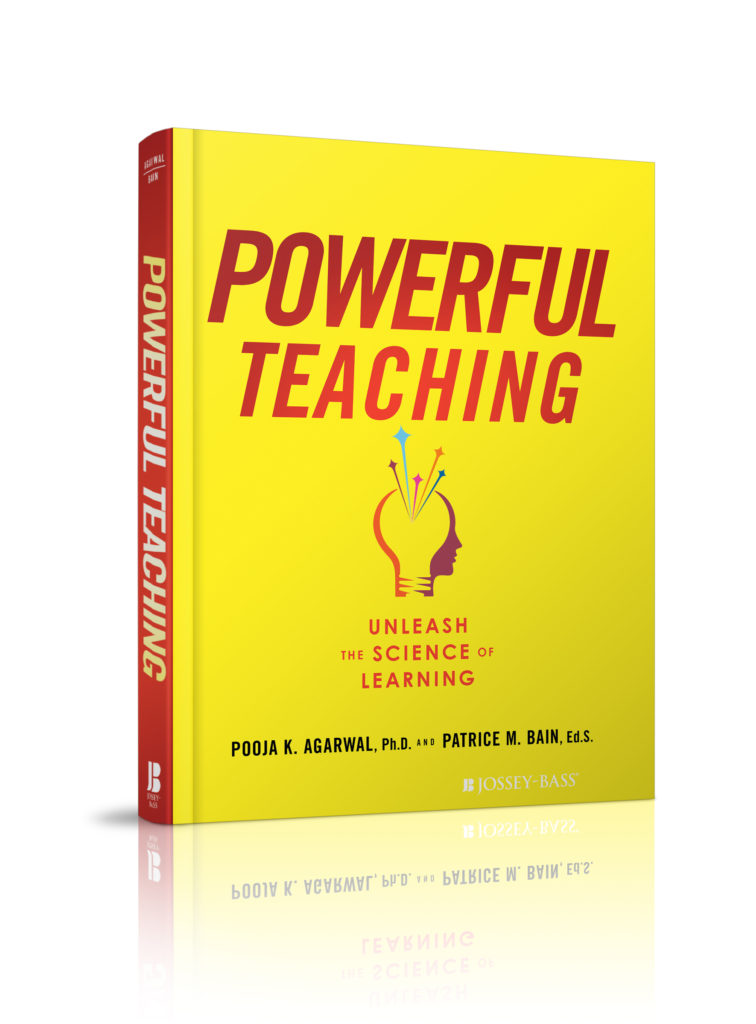
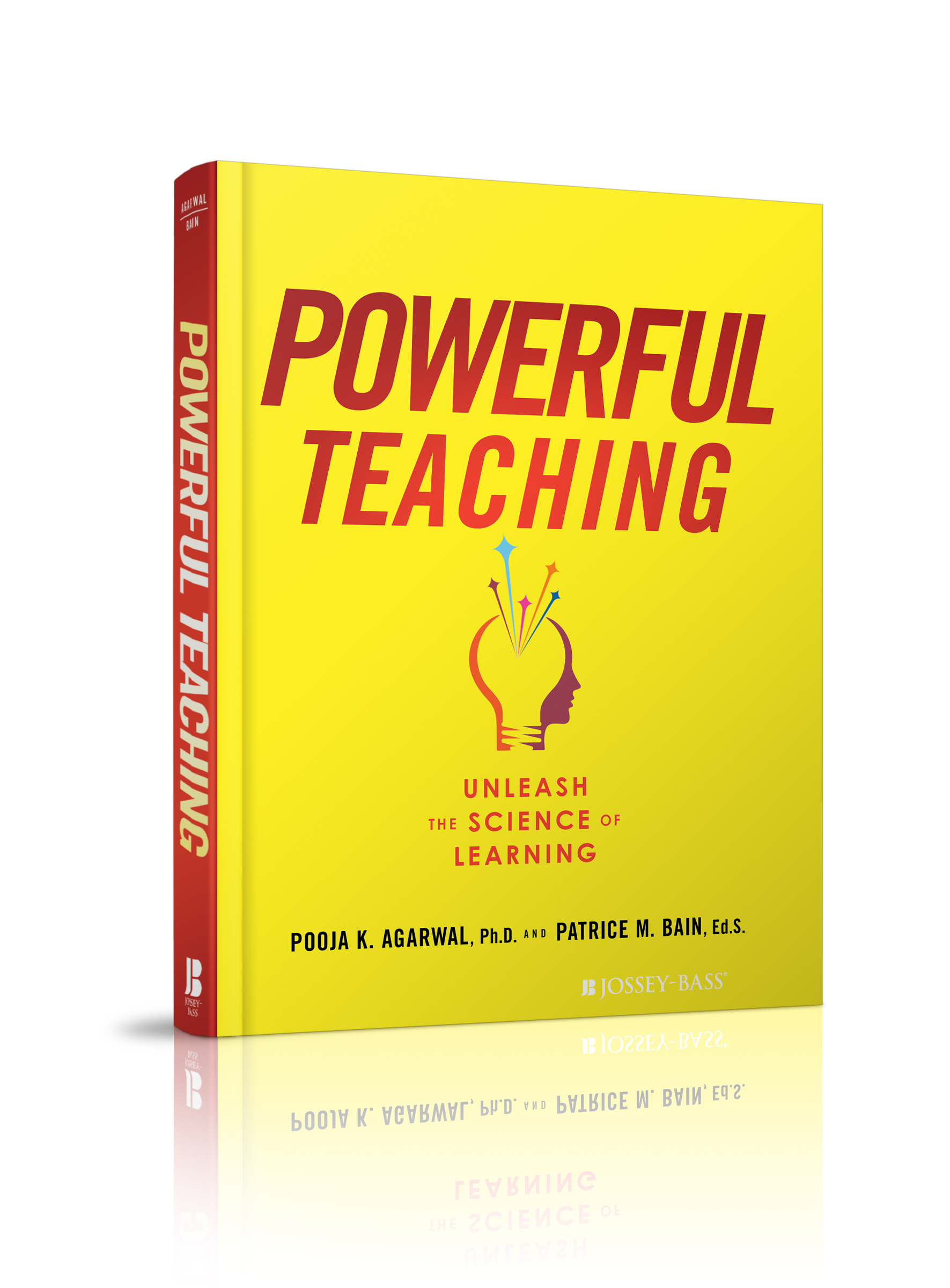
Memory researcher Pooja Agarwal and teacher Patrice Bain have written Powerful Teaching: Unleash the Science of Learning. Let’s see how their book stacks up against our (impossible) criteria:

First: Begins with Research

If you attend Learning and the Brain conferences, you prioritize brain research.

We’re not here for the fads. We’re here for the best ideas that can be supported by psychology and neuroscience.

Happily, Powerful Teaching draws its classroom guidance from extensive research.

Citing dozens of studies done over multiple decades, Agarwal and Bain champion four teaching strategies: retrieval practice, spacing, interleaving, and metacognition.

(As frequent blog readers, you’ve read lots about these topics.)

Agarwal herself did much of the research cited here. In fact, (researcher) Agarwal did much of the on-the-ground research in (teacher) Bain’s classrooms.

And Agarwal studied and worked with many of the best-know memory researchers in the field: “Roddy” Roediger, Mark McDaniel, and Kathleen McDermott, among others.

(BTW: McDaniel will be speaking at the LatB conference this fall in Boston.)

In short: if you read a recommendation in Powerful Teaching, you can be confident that LOTS of quality research supports that conclusion.

Second: Offers Classroom Specifics

Powerful Teaching is written by two teachers. Bain taught 6-8 grade for decades. And Agarwal is currently a psychology professor.

For this reason, their book BOTH offers research-based teaching advice AND gives dozens of specific classroom examples.

What does retrieval practice look like in the classroom? No worries: they’ve got you covered.

This strength merits particular attention, because it helps solve a common problem in our field.

Teachers often hear researchers say, “I studied this technique, and got a good result.” We infer that we should try that same technique.

But, most research takes place in college classrooms. And, the technique that works with that age group just might not work with our students.

How should we translate these research principles to our classrooms? Over and over again — with specific, practical, and imaginative examples — Bain and Agarwal show us how.

Third: Welcomes Teachers

Increasingly in recent months, I’ve seen scholars argue that teacherly instincts should not be trusted. We should just do what research tells us to do.

As I’ve written elsewhere, I think this argument does lots of damage—because we HAVE to use our instincts.

How exactly do research-based principles of instruction work in thousands of different classrooms? Teachers have to adapt those principles, and we’ll need our experience —and our instincts—to do so.

Powerful Teaching makes exactly this point. As Bain and Agarwal write:

You can use Power Tools your way, in your classroom. From preschool through medical school, and biology to sign language, these strategies increase learning for diverse students, grade levels, and subject areas. There are multiple ways to use these strategies to boost students’ learning, making them flexible in your classroom, not just any classroom.

Or, more succinctly:

The better you understand the research behind the strategies, the more effectively you can adapt them in your classroom – and you know your classroom best.

By including so many teachers’ experiences and suggestions, Agarwal and Bain put teacherly insight at the center of their thinking. They don’t need to argue that teachers should have a role; they simply show us that it’s true.

Fourth: Lively Voice

Scientific research offers teachers lots of splendid guidance … but if you’ve tried to read the research, you know it can be dry. Parched, even.

Happily, both Bain and Agarwal have lively writing voices. Powerful Teaching doesn’t feel like a dry lecture, but a friendly conversation.

For example:

Learning is complex and messy, it’s not something we can touch, and it’s really hard to define. You might even say that the learning process looks more like a blob than a flowchart.

Having tried to draw many learning flowcharts, only to end up with blobs, I appreciate this honest and accurate advice.

What’s Not to Love?

As a reviewer, I really should offer at least some criticism of Power Tools. Alas, I really don’t have much – at least not much substantive.

Once or twice, I thought that the research behind a particular finding is more muddled that PT lets on. For example, as I’ve written about before, we’ve got contradictory evidence about the benefits of retrieval practice for unstudied material.

But, as noted above, Agarwal is an important researcher in this field, and so I’m inclined to trust her judgment.

Mostly, I think you should put Powerful Teaching at the top of your summer reading list. You might sign up for the summer book club. Keep on eye on the website for updates.

Visual & Verbal: Welcome to “Dual Coding”
Andrew Watson
Andrew Watson

Over at LoveToTeach87, Kate Jones has written a thoughtful and thorough exploration of Dual Coding.

What is “dual coding”? In brief, when we take care to present information in two formats — visual and verbal — we are dual coding.

Schools too often focus on verbal presentation of information. Dual coding theory reminds us to add visuals as well.

Jones’s post begins with a helpful over view of recent work in the field: in particular, the Learning Scientists, and also Oliver Caviglioli.

She then changes gears, and offers a variety of specific classroom for putting this concept into practice:

timelines

comics/storyboards

revised notes

summary cards

And so forth. Because her post includes so many splendid examples, I encourage you to check it out.

Behind the What, the Why

But, why exactly does dual coding help?

The short answer is: lots of reasons. But for me, the core answer comes back — as it so often does — to working memory.

Working memory allows brains to hold, reorganize, and combine information. In other words: all academic learning requires working memory.

And: we just don’t have very much. (Alas, there’s no artificial way to increase it. Yet.)

But, we do have a secret supply of extra working memory. More precisely, we have different WM stores for visual and auditory information.

If I present information only verbally, then students must hold all that information with that part of their WM.

It’s like doing mental push-ups with one arm.

But, if I provide information both verbally and visually, they get to use both parts of their WM.

And, of course, two arm push-ups are much easier to do.

In sum: dual coding helps students learn, because it divides WM load between verbal and visual capacities.

A Brief Warning

This teaching advice sounds a bit like learning styles. It suggests that we’ve got distinct visual and verbal learning capacities.

PLEASE do not confuse these two theories. Learning styles theory has no support — it just ain’t true.

We ALL use visual WM. We ALL use auditory WM. (Those of us who have sight and hearing.)

There is no “style” here. This cognitive architecture supports learning for us all.

And so, dual coding benefits practically everyone.