
classroom – Education & Teacher Conferences Skip to main content
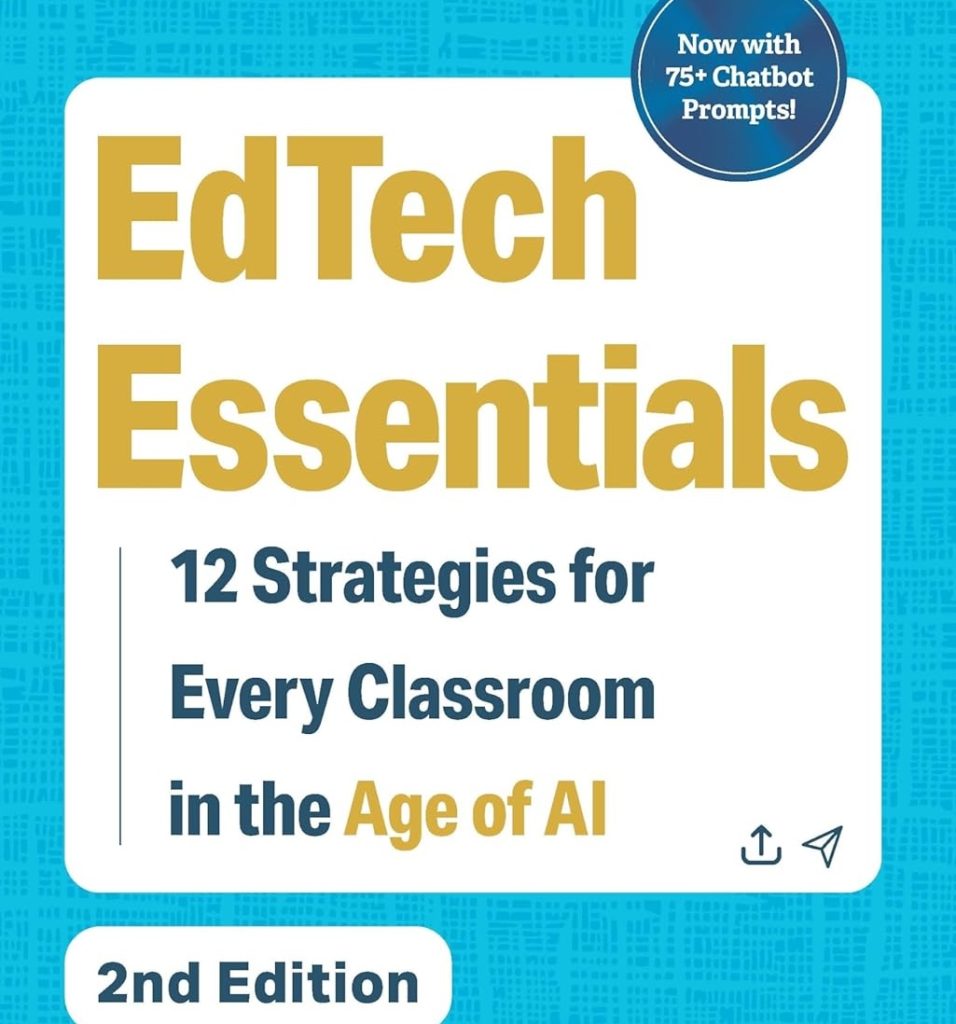
EdTech Essentials by Monica Burns
Erik Jahner, PhD
Erik Jahner, PhD

In many classrooms, Ed Tech like generative AI has quietly altered the emotional climate. Conversations that once centered on learning now carry an undercurrent of suspicion—Who used AI? How much? Was this allowed? The effort to catch students in the act, however well-intentioned, can introduce tensions more disruptive than the technology itself. EdTech Essentials: 12 Strategies for Every Classroom in the Age of AI (2nd Edition) does not dwell in a policing mindset. Instead, Burns focuses on the literacies that make those tensions less central: helping students become capable, discerning participants in digital spaces. While the original edition was not written with AI in mind, the revised edition treats AI as a defining pressure of the moment—using it to reframe enduring questions about teaching rather than allowing it to overshadow them.

At its core, this book is not about tools. It is about judgment. Burns positions educational technology not as a solution in search of a problem, but as a set of skills, habits, and dispositions students must develop if they are to navigate an increasingly complex world with discernment. The twelve “essentials” read less like a checklist and more like a practical philosophy—pedagogy in the foreground, technology in a supporting role. That ordering matters, especially at a moment when AI threatens to dominate instructional conversations. While the revision foregrounds AI, most of the book is devoted to foundational digital learning practices that long predate generative models—and supersede them.

What struck me most is how calmly Burns handles the presence of AI. There is no breathless futurism here, and no reactionary moral panic. AI is treated as another literacy demand—powerful, imperfect, and worthy of scrutiny. The chapters on generating ideas with AI and evaluating digital content with an “AI mindset” stand out not because they offer restrictions, but because they encourage educators to slow down and ask better questions. What does this tool do well? Where does it mislead? How do students learn to notice the difference?

This is where the book quietly—but distinctly—shines. Burns’ emphasis on transfer is grounded in the lived reality of students moving across search engines, shared documents, media platforms, and AI tools that rarely announce their assumptions or limitations. Skills such as navigating online spaces, curating resources, and collaborating digitally are framed not as isolated competencies but as habits of judgment that must hold across contexts. Her use of modeling, think-alouds, and scaffolded exploration is about making invisible decision-making visible—how to choose sources, ignore distractions, question generated content, and organize thinking when access and prior experience vary widely. In a field where digital fluency is often assumed rather than taught, Burns insists that these skills are learned, not inherited.

The book is also grounded in classroom reality. Burns does not assume one-to-one devices, flawless bandwidth, or unlimited planning time. Her examples span grade levels and subject areas, making it easy to imagine these strategies living inside real lessons rather than hovering above them. Paired with consistent connections to ISTE standards, this practicality makes EdTech Essentials useful not only for classroom teachers, but also for instructional coaches and school leaders seeking coherence between vision and practice.

The design strengthens the message. The second edition integrates AI not by overhauling the text, but by extending it—adding focused chapters while keeping the broader framework intact. The appendices reinforce this restraint: planning tools, chapter summaries, a study guide for collective learning, and a carefully framed set of chatbot prompts that emphasizes review and judgment. Even the tool lists are organized by instructional purpose rather than novelty. This is a book built to be revisited.

What distinguishes EdTech Essentials from many recent books on AI and teaching is that same steadiness. After a wave of titles that catalog tools, debate detection, or speculate about the future of assessment, Burns’ approach feels intentionally stable. Rather than asking educators to redesign coursework with every new model release, she grounds her guidance in enduring practices—navigation, evaluation, collaboration, creation, and transfer. AI enters the conversation not as a disruption to outpace, but as one more context in which these skills must be taught.

One implication of Burns’ approach is that it treats trust as a design problem rather than a behavioral one. When students are explicitly taught how to navigate, evaluate, and create responsibly in digital spaces, the need for constant suspicion diminishes. Education works best when we stop trying to catch students doing the wrong thing and start teaching them how to do the right thing well. In an era shaped by AI, that reframing may be the most essential strategy of all.

Introducing “Interteaching” (Works Online Too!)
Andrew Watson
Andrew Watson

Have you heard of “interteaching” before? Me neither.

The headlines for this blog sound like this:

“INTERTEACHING” HELPFULLY BALANCES TEACHER AND STUDENT EFFORT/RESPONSIBILITY

and

“INTERTEACHING” WORKS ONLINE AND ASYNCHRONOUSLY, according to recent research.

Let’s take those headlines one at a time.

Headline 1: A Helpful Balance of Work and Responsibility

Few battles rage hotter in education than the “teacher-centered” vs. “student-centered” debate. Should teachers be “sages” who explain ideas and procedures directly and precisely? Should we be “guides” who help students as they puzzle their way to discovery and understanding?

We can be tempted to think that one approach is always right, the other always wrong.

Interteaching, as I understand it, strikes a useful middle ground.

Teachers do plenty of organizing/presenting. And, students devote lots of mental energy to figuring out key ideas. As explained in this study by Gayman, Hammonds, and Rost, Interteaching includes four steps:

First: As students do assigned readings, they answer questions included in “prep-guides.” In other words: teachers guide and signal with the questions they ask, but students do the mental work to figure out the answers.

Second: Students meet in small groups (2-4) to compare answers and figure out  their disagreements. Here, again, students must do lots of useful mental work.

Third: Students tell teachers (in “record sheets”) which concepts they struggled most to understand. Notice: time for student metacognition.

Fourth: Guided by that feedback, teachers prepare and present a brief lecture to explain the trickiest ideas. After several steps focused on student effort, this one invites teachers to do the heavy lifting.

By the way, an optional fifth step creates a grade incentive to encourage student participation. According to Gayman and Co., the method works with or without those incentives.

As you can see, interteaching combines “student-centered” discussions and metacognition with “teacher-centered” prep-guides and lectures. We end up being both guides and sages, depending on the step we’re in.

Headline #2: Interteaching Helps Online/Asynchronous Learners

Gayman’s study cites prior research showing the benefits of interteaching. (Short version: students learn more.)

She and her colleagues, want to know: does this approach also help students learn online, especially in asynchronous classes?

To find out, Gayman used one of her own psychology courses as a testing ground. In one section, she taught topics A, C, and E the traditional lecturey way, and topics B, D, and F with interteaching.

With the other section, she flipped that: B, D, and F got traditional lectures, and A, C, and E got interteaching love.

With this method, she could determine within the same student which method worked better.

Turns out: students learned more from interteaching as measured by unit-end quizzes. And on the final exam. (Those exams yielded more As and Bs for inter-taught material, and fewer Cs, Ds, and Fs.)

And, 82% of the students said they preferred interteaching classes to lectures.

So: yes, interteaching helps online learners, even in asynchronous classes.

Always with the Nuance

I haven’t yet found any research looking at interteaching in K-12 classrooms.

I suspect that students need a well-developed academic skills to manage the more independent parts of this approach. That is: I would hypothesize that the method works better in high school and college than with earlier grades.

In particular, the metacognitive step — the “record sheets” — could be very challenging for younger students. Even my high-school sophomores don’t reliably understand what they don’t understand. (Dunning-Kruger, I’m looking at you.)

At the same, I imagine that the underlying concepts (a balance of “student- and teacher-centeredness”) could be wisely adapted for students at various stages in their academic careers.

I’ll also be curious to hear how this approach works with different subjects (math, history, art, dance) and in different cultural contexts.


In brief: I’m intrigued by this approach, and look forward to exploring it in future posts. If only I had known about it a year ago!

Have I Been Spectacularly Wrong for Years? New Research on Handwriting and Learning
Andrew Watson
Andrew Watson

Long-timer readers know my weakness.

I’m usually an easy-going guy. But if you want to see me frantic with frustration, tell me about the superiority of handwriting for taking notes.

Here’s the story.

Back in 2014, two Princeton researchers did a study which concluded that handwritten notes lead to better learning than notes taken on laptops.

That’s a helpful question to have answered, and so I read their study with a mixture of curiosity and gratitude.

Imagine my surprise when I found that their conclusion rests on the assumption that students can’t learn to do new things. (That’s a VERY weird belief for a teacher to have.)

If you believe a student CAN learn new to do things, then the researchers’ data strongly suggest that laptop notes will be better.

Oh, and, by the way, their study does not replicate.

Despite these glaring flaws, people still cite this study — and look at me with pity (contempt?) when I try to convince them otherwise. “But research says so,” they say wearily. I seethe, but try to do so politely.

Today’s Exciting News

When I try to explain my argument, my interlocutor often says something like “handwriting engages more neural processing through kinesthetic yada yada,” and therefore boosts learning.

In the first place, that’s NOT the argument that the Princeton researchers make. It might be true, but that’s changing the subject — never a good way to prove a point.

In the second place, where is the evidence of that claim? I’d love to review it.

To date, no one has taken me up on that offer.

But — [sound of trumpets blaring] — I recently found a post at Neuroscience News with this splendid headline: “Why Writing by Hand Makes Kids Smarter.”

Here’s the first sentence of the article:

Children learn more and remember better when writing by hand, a new study reports. The brains of children are more active when handwriting than typing on a computer keyboard.

“Learn more.” “Remember better.” That’s impressive. At last: the research I’ve been asking for all these years!

Believe it or not, I rather enjoy finding research that encourages me to change my mind. That process reminds me of the power of the scientific method. I believe one thing until I see better evidence on the other side of the argument. Then I believe the other thing.

So, AT LAST, I got to read the research showing that handwriting helps students learn more and remember better.

Want to know what I found?

The Study

The researchers did not test anyone’s learning or memory.

You read that right. This article claims that handwriting improves learning and memory, but they didn’t test those claims.

This research team asked 24 participants — twelve adults and twelve 12-year-olds — to write by hand, or write on a laptop. They then observed the neural regions involved in those tasks.

Based on what they saw, they inferred that handwriting ought to result in better learning.

But they did not test that hypothesis.

So, based on a tiny sample size and a huge leap of neuro-faith, they have concluded that handwriting is better. (And, astonishingly, some big names in the field have echoed this claim.)

The Bigger Picture

Believe it or not, I’m entirely open to the possibility that handwritten notes enhance learning more than laptop notes do.

I’m even open to the possibility that kinesthetic yada yada is the reason.

To take one example, Jeffrey Wammes has done some splendid research showing that — in specific circumstances — drawing pictures helps students remember words and concepts.

If drawing boosts learning, maybe handwriting does too. That’s plausible.

But here’s the thing: before Wammes made his claim, he tested the actual claim he made.

He did not — as the Princeton researchers did — start from the assumption that students can’t learn to do new things.

He did not — as this current research does — extrapolate from neural patterns (of 24 people!) to predict how much learning might happen later on.

Wammes designed a plausible study to measure his hypothesis. In fact, he worked hard to disprove his interpretation of the data. Only when he couldn’t did he admit that — indeed — drawing can boost learning.

Before I believe in the superiority of either handwritten notes or laptop notes, I want to see the study that works hard to disprove its own claims. At present, the best known research on the topic conspicuously fails to meet that test.

Do you know of research that meets this standard? If yes, please let me know!