
classroom advice – Page 7 – Education & Teacher Conferences Skip to main content
The Best Teaching Advice We’ve Got
Andrew Watson
Andrew Watson

You want to improve your teaching with psychology research?

We’ve got good news, and bad news.

And more good news.

Good News: we have lots and LOTS of research. We can talk about attention, or working memory, or the spacing effect, or motivation, or stress…the list is long. And super helpful.

So much practical advice!

Bad News: actually, the bad news is the same as the good news. We’ve got SO MUCH good research that it’s honestly hard to keep track of it all.

I mean, seriously. Should you start by looking at attention research? Or stress research?

Should we think about the motivational effects of student-teacher relationships, or the perils of working memory overload, or the benefits of desirable difficulty?

Which is most important?

Honestly, I think our next priority is not so much finding out new truths about learning, but organizing all the information we already have.

More Good News

If you agree that we really need someone to sort all these suggestions into a coherent system, you’ll be delighted to read this article by Stephen Chew (Twitter handle: @SChewPsych) and William Cerbin (@BillCerbin).

Other scholars — for instance, Barak Rosenshine — have put together a coherent system based on learning principles. Chew and Cerbin, instead, organize their system around cognitive challenges.

That is:

If students feel anxiety about a topic or discipline, that emotion will interfere with their learning.

If students have prior misconceptions, they will distort students’ understanding.

If classroom work or assignments go beyond working memory limits, students won’t learn effectively (or, at all).

When planning a course or a lesson or an assignment, teachers can think their way through these specific challenges. By contemplating each one, we can design our work to best facilitate learning.

Getting the Emphasis Right

If you’re thinking “this is such excellent news! It just can’t get any better!” — well — I’ve got some news: it gets better.

Chew and Cerbin write:

There is no single best teaching strategy for all students, topics, and situations. The proposed framework is not prescriptive … and can guide adaptation of teaching practice.

In other words, they’re not saying: here’s a list of things to do.

Instead, they are saying: here are several topics/problems to consider.

Teaching advice should not include “best practices.” (That’s a business concept.) It should include “best questions to ponder as we make decisions.” Chew and Cerbin make this point repeatedly.

Frequent readers know that I’ve been banging on for years with this mantra: “Don’t just do this thing; instead, think this way.”

We should think about our students’ working memory limitations. The strategies we use might differ for 1st graders and 8th graders.

We should think about the importance of transfer. A Montessori school and a KIPP school will (almost certainly) use differing strategies to reach that goal.

We should think about our students’ prior knowledge. The best way to measure that knowledge might be different for students with diagnosed learning differences.

Yes: we should consider these nine topics. But the ways we answer them must depend on our students, our schools, our curriculum, and ourselves.

For all these reasons, I recommend Chew and Cerbin’s article with great enthusiasm.

And, happily, you can meet Dr. Chew at our online conference in February! (In case you’re wondering: I was planning to write about this article before I knew he was joining the conference. A happy synchronicity.)

“But How Do We Know If It Works in the Classroom?”: The Latest on Retrieval Practice
Andrew Watson
Andrew Watson

We’ve heard so much about retrieval practice in the last two years that it seems like we’ve ALWAYS known about its merits.

But no: this research pool hasn’t been widely known among teachers until recently.

We can thank Agarwal and Bain’s wonderful Powerful Teaching for giving it a broad public audience. (If you had been attending Learning and the Brain conferences, of course, you would have heard about it a few years before that.)

Of course, we should stop every now and then to ask ourselves: how do we know this works?

In this case, we’ve got several answers.

In addition to Agarwal and Bain’s book, both Make it Stick (by Brown, Roediger, and McDaniel) and How We Learn (by Benedict Carey) offer helpful surveys of the research.

You could also check out current research. Ayanna Kim Thomas recently published a helpful study about frequent quizzing in college classrooms. (It helps!)

All these ways of knowing help. Other ways of knowing would be equally helpful.

For instance: I might want to know if retrieval practice helps in actual classrooms, not just in some psychology lab somewhere.

Yes, yes: Agarwal and Bain’s research mostly happened in classrooms. But if you’ve met them you know: it might work because they’re such engaging teachers! What about teachers like me — who don’t quite live up to their energy and verve?

Today’s News

A recent meta-analysis looked at the effect on retrieval practice in actual classrooms with actual students. (How many students? Almost 8000 of them…)

Turns out: retrieval practice helps when its studied in psychology labs.

And, it helps when vivacious teachers (like Agarwal and Bain) use it.

And, it helps when everyday teachers (like me) use it.

It really just helps. As in: it helps students learn.

A few interesting specifics from this analysis:

First: retrieval practice quizzes helped students learn more when they were counted for a final grade than when they weren’t. (Although: they did help when not counted toward the grade.)

Second: they helped more when students got feedback right away than when feedback was delayed. (This finding contradicts the research I wrote about last week.)

Third: short answer quizzes helped learning more than multiple choice (but: multiple choice quizzes did produce modest benefits).

Fourth: announced quizzes helped more than unannounced quizzes.

and, by the way

Fifth: retrieval practice helped middle-school and high-school students more than college students. (Admittedly: based on only a few MS and HS studies.)

In brief: all that good news about retrieval practice has not been over sold. It really is among the most robustly researched and beneficial teaching strategies we can use.

And: it’s EASY and FREE.

A Final Note

Because psychology research can be — ahem — written for other psychology researchers (and not for teachers), these meta-analyses can be quite daunting. I don’t often encourage people to read them.

In this case, however, authors Sotola and Crede have a straightforward, uncomplicated prose style.

They don’t hold back on the technical parts — this is, after all, a highly technical kind of writing.

But the explanatory paragraphs are unusually easy to read. If you can get a copy — ask your school’s librarian, or see if it shows up on Google Scholar — you might enjoy giving it a savvy skim.

“Sooner or Later”: What’s the Best Timing for Feedback?
Andrew Watson
Andrew Watson

Given the importance of feedback for learning, it seems obvious teachers should have well-established routines around its timing.

In an optimal world, would we give feedback right away? 24 hours later? As late as possible?

Which option promotes learning?

In the past, I’ve seen research distinguishing between feedback given right this second and that given once students are done with the exercise: a difference of several seconds, perhaps a minute or two.

It would, of course, be interesting to see research into longer periods of time.

Sure enough, Dan Willingham recently tweeted a link to this study, which explores exactly that question.

The Study Plan

In this research, a team led by Dr. Hillary Mullet gave feedback to college students after they finished a set of math problems. Some got that feedback when they submitted the assignment; others got it a week later.

Importantly, both groups got the same feedback.

Mullet’s team then looked at students’ scores on the final exams. More specifically, if the students got delayed feedback on “Fourier Transforms” — whatever those are — Mullet checked to see how they did on the exam questions covering Fourier.

And: they also surveyed the students to see which timing they preferred — right now vs. one week later.

The Results

I’m not surprised to learn that students strongly preferred immediate feedback. Students who got delayed feedback said they didn’t like it. And: some worried that it interfered with their learning.

Were those students’ worries correct?

Nope. In fact, just the opposite.

To pick one set of scores: students who got immediate feedback scored 83% on that section of an exam. Students who got delayed feedback scored a 94%.

Technically speaking, that’s HUGE.

Explanations and Implications

I suspect that delayed feedback benefitted these students because it effectively spread out the students’ practice.

We have shed loads of research showing that spacing practice out enhances learning more than doing it all at once.

So, if students got feedback right away, they did all their Fourier thinking at the same time.  They did that mental work all at once.

However, if the feedback arrived a week later, they had to think about it an additional, distinct time. They spread that mental work out more.

If that explanation is true, what should teachers do with this information? How should we apply it to our teaching?

As always: boundary conditions matter. That is, Mullet worked with college students studying — I suspect — quite distinct topics. If they got delayed feedback on Fourier Transforms, that delay didn’t interfere with their ability to practice “convolution.”

In K-12 classrooms, however, students often need feedback on yesterday’s work before they can undertake tonight’s assignment.

In that case, it seems obvious that we should get feedback to them ASAP. As a rule: we shouldn’t require new work on a topic until we’ve given them feedback on relevant prior work.

With that caveat, Mullet’s research suggests that delaying feedback as much as reasonably possible might help students learn. The definition of “reasonably” will depend on all sorts of factors: the topic we’re studying, the age of my students, the trajectory of the curriculum, and so forth.

But: if we do this right, feedback helps a) because feedback is vital, and b) because it creates the spacing effect. That double-whammy might help our students in the way it helped Mullet’s. That would be GREAT.


“Rich” or “Bland”: Which Diagrams Helps Students Learn Deeply?
Andrew Watson
Andrew Watson

Here’s a practical question: should the diagrams we use with students be detailed, colorful, bright, and specific?

Or, should they be simple, black and white, somewhat abstract?

We might reasonably assume that DETAILS and COLORS attract students’ attention. If so, they could help students learn.

We might, instead, worry that DETAILS and COLORS focus students’ attention on surface features, not deep structures. If so, students might learn a specific idea, but not transfer their learning to a new context.

In other words: richly-decorated diagrams might offer short-term benefits (attention!), but result in long-term limitations (difficulties with transfer). If so, blandly-decorated diagrams might be the better pedagogical choice.

Today’s Research

Scholars in Wisconsin — led by David Menendez — have explored this question.

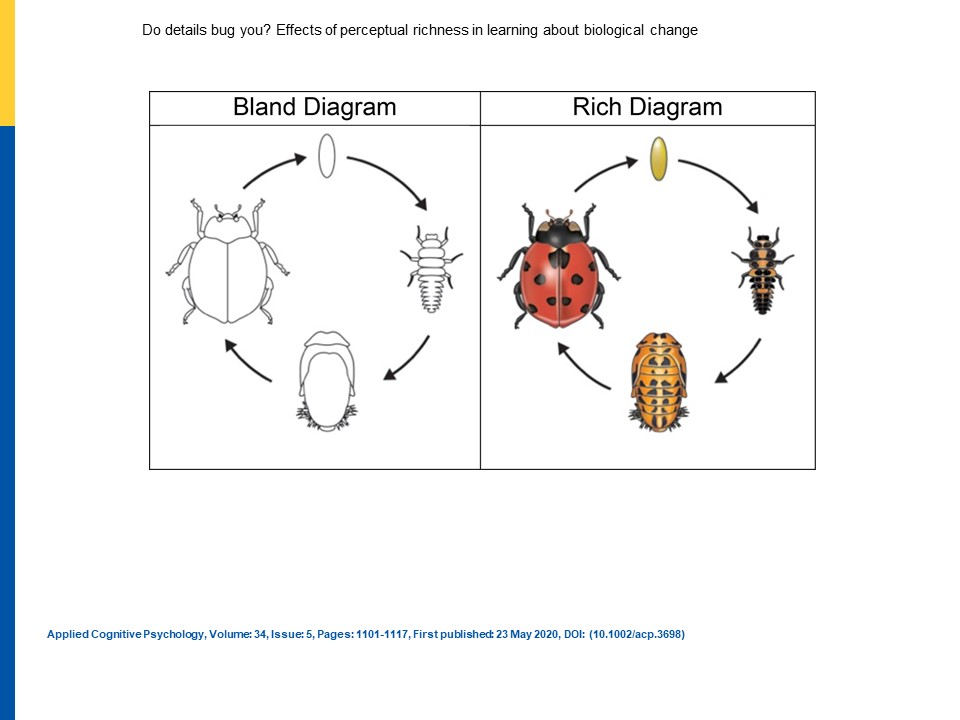
Specifically, they asked college students to watch a brief video about metamorphosis. (They explained that the video was meant for younger students, so that the cool college kids wouldn’t be insulted by the simplicity of the topic.)

For half the students, that video showed only the black-and-white diagram to the left; for the other half, the video showed the colors and dots.

Did the different diagrams shape the students’ learning? Did it shape their ability to transfer that learning?

Results, Please…

No, and yes. Well, mostly yes.

In other words: students who watched both videos learned about ladybug metamorphosis equally well.

But — and this is a BIG but — students who watched the video with the “rich” diagram did not transfer their learning to other species as well as students who saw the “bland” diagram.

In other words: the bright colors and specifics of the rich diagram seem to limit metamorphosis to this specific species right here. An abstract representation allowed for more successful transfer of these concepts to other species.

In sum: to encourage transfer, we should use “bland,” abstract diagrams.

By the way: Team Menendez tested this hypothesis with both in-person learners and online learners. They got (largely) the same result.

So: if you’re teaching face-to-face or remotely, this research can guide your thinking.

Some Caveats

First: as is often the case, this effect depended on the students’ prior knowledge. Students who knew a lot about metamorphosis weren’t as distracted by the “rich” details.

Second: like much psychology research, this study worked with college students. Will its core concepts work with younger students?

As it turns out, Team Menendez has others studies underway to answer that very question. Watch This Space!

Third: Like much psychology research, this study looked at STEM materials. Will it work in the humanities?

What, after all, is the detail-free version of a poem? How do you study a presidency without specifics and details?

When I asked Menendez that question, he referred me to a study about reader illustrations. I’ll be writing about this soon.

In Sum

Like seductive details, “rich” diagrams might seem like a good teaching idea to increase interest and attention.

Alas, that perceptual richness seems to help in the short term but interfere with transfer over time.

To promote transfer, teach with “bland” diagrams — and use a different strategy to grab the students’ interest.

“Before You Change Your Teaching, Change Your Thinking”
Andrew Watson
Andrew Watson

When I attended my first Learning and the Brain conference, more than a decade ago, I had a simple plan:

Step 1: Listen to the researcher’s advice.

Step 2: Do what the researcher told me to do.

Step 3: Watch my students learn more.

Step 4: Quietly glow in the satisfaction that my teaching is research-based.

In fact, I tried to follow that plan for several years. Only gradually did I discover that it simply couldn’t work.

Why?

Because researchers’ advice almost always applies to a very specific, narrow set of circumstances.

The teaching technique they use to help — say — college students learn calculus might not help my 10th graders write better Macbeth essays.

Or: their teaching strategy encourages a technology that my Montessori school forbids.

Or: research on American adolescents might not yield results that help teens raised in other cultures.

In other words: psychology and neuroscience research don’t provide me a handy checklist. I don’t just need to change what I do; I need to change how I think. I really wish someone had said to me:

“Before you change your teaching, change your thinking.”

Example the First

I thought of this advice when I saw a recent Twitter post by Otto Warman (@MrOWarman), a math teacher in Britain.

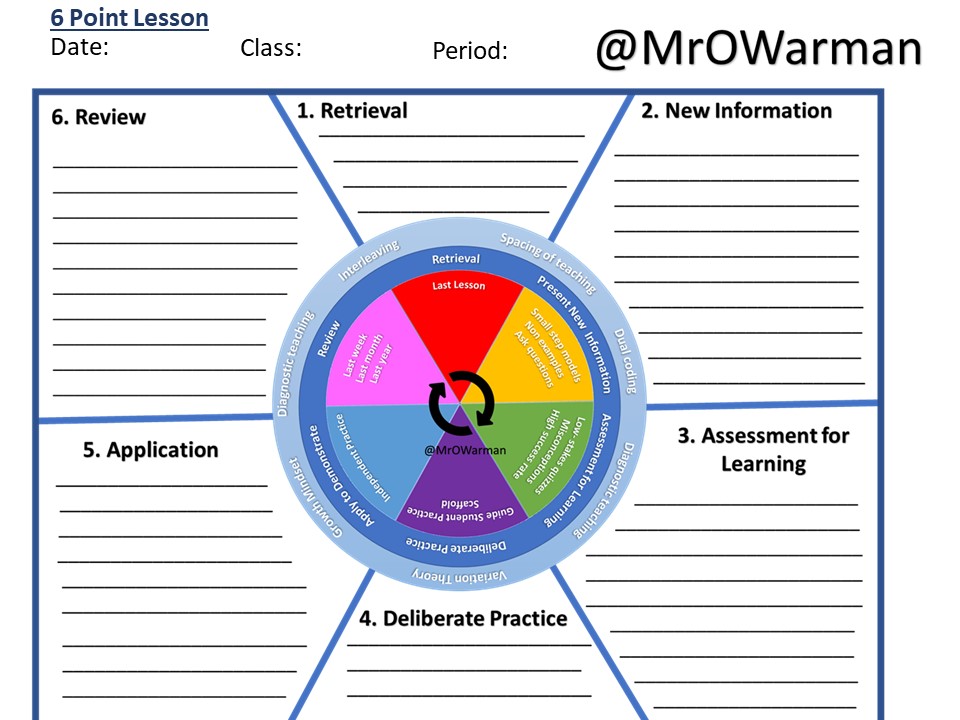
Warman has gone WAY beyond following a researcher’s checklist. Instead, he has synthesized an impressive amount of research, and reorganized it all into a lesson-planning system that works for him.

As you can see, his lesson plan form (which he has generously shared) prompts him to begin class with retrieval practice, then to introduce new information, then to check for understanding, and so forth. (You can click on the image to expand it.)

Each circle and slice of the diagram includes helpful reminders about the key concepts that he’s putting into action.

That is: he’s not simply enacting someone else’s program in a routinized way. He has, instead, RETHOUGHT his approach to lesson planning in order to use research-supported strategies most appropriately and effectively.

To be clear: I DO NOT think you should print up this sheet and start using it yourself. That would be a way to change what you do, not necessarily a way to change what you think. The strategies that he has adopted might not apply to your students or your subject.

Instead, I DO THINK you should find inspiration in Warman’s example.

What new lesson plan form would you devise?

Are there cognitive-science concepts you should prioritize in your teaching?

Will  your students benefit especially from XYZ, but not so much from P, Q, or R?

The more you reorganize ideas to fit your particular circumstances, the more they will help your teaching and your students.

Example the Second

Over on his blog (which you should be reading), Adam Boxer worries that we might be making a mess of retrieval practice.

Done correctly, retrieval practice yields all sorts of important benefits. Done badly, however, it provides few benefits. And takes up time.

For that reason, he explains quite specifically how his school has put retrieval practice to work. As you’ll see when you review his post, this system probably won’t work if teacher simply go through the steps.

Instead, we have to understand the cognitive science behind retrieval practice. Why does it work? What are the boundary conditions limiting its effectiveness? How do we ensure that the research-based practice fits the very specific demands of our classes, subjects, and students?

Retrieval practice isn’t just something to do; it’s a way to think about creating desirable difficulty. Without the thinking, the doing won’t help.

To Sum Up

What’s the best checklist for explaining a concept clearly? There is no checklist: think differently about working memory and schema theory.

What’s the best daily schedule for a school? There is no best schedule: think differently about attention.

What steps help are most powerful to help students manage stress? Before we work steps, we have to think differently about students’ emotional and cognitive systems.

To-do lists are straightforward and easy. Teaching is complex and hard. Think different.

“Successive Relearning”: 1 + 1 = +10%
Andrew Watson
Andrew Watson

We teachers get LOTS of advice from cognitive science. Research tells us to…

…monitor and manage our students’ stress levels.

…use mid-class exercise to enhance attention.

interleave topics to create desirable difficulties.

Each individual suggestion has lots of research behind it, and we’re glad to get these ideas.

But: what happens when we start thinking about combinations?

If we use more than one technique at a time, do the benefits add onto each other? Do they conflict with each other? How can we link up research-informed strategies to create the best overall learning experience?

Focus on Memory

In the last ten years, we’ve seen a real explosion in research about long-term memory formation (aka, learning).

We’ve seen that retrieval practice takes no more time than simple review, but results in lots more learning.

We’ve seen that spreading practice out (aka, spacing) helps students learn better than bunching practice together.

So, here’s the big question: what happens if we do both? Is retrieval practice + spacing more powerful than each technique by itself? Is 1+1 greater than 2?

A research team at Kent State recently explored this question.

In this study, researchers developed a complex study paradigm that created both retrieval practice and spacing. Unlike some retrieval practice exercises — which simply require students to try to remember the answer — this paradigm required students to get questions correct before they were done.

Researchers called this combination successive relearning. Students used successive relearning for some of the topics they learned in an advanced biopsychology course. They used their regular (“business-as-usual”) study techniques for the others.

Did successive relearning help students learn?

Answers, and More Questions

To some degree, the answer to that question is: it depends on what you compare to what.

Should the researchers compare this year’s students to last year’s students in the same course?

Should they compare students’ memory of topics where they did use successive relearning to topics where they didn’t?

Being thorough, this research team compared lots of variables to lots of other variables. Quite consistently, they found that “successive relearning” helped.

That is: this year’s students learned more than last year’s. Among this year’s students, successive relearning helped students remember more than their “business-as-usual” strategies.

Roughly speaking, students remembered at least 10% more using successive relearning than other strategies.

So: 1 + 1 = +10%

Case closed.

Case Reopened?

But wait just a minute here.

If you’ve got a good memory, this blog post might be ringing some bells.

Back in February of this year, I wrote about a study in which spacing helped students learn, but — in the long run — retrieval practice didn’t.

If you’ve got an AMAZING memory, you might recall a blog post from June of 2018. Researchers polled students about their study habits. They found that students did benefit from their own retrieval practice, but did not benefit from their spacing — the exact opposite result.

What’s going on here? Why did the two studies differ from each other? Why are they different from this study I’ve just described?

My hypothesis: specifics matter.

In those previous studies, the classes already included one of these techniques.

That is: the study I wrote about in February looked at a math class. Math classes already include lots of retrieval practice, because problem solving is a kind of RP. So, additional retrieval practice didn’t help. But the spacing did.

And, in the class I wrote about in 2018, the professor’s syllabus already included lots of spacing: cumulative review sheets and cumulative exams. So additional spacing done by the students  didn’t help. But their retrieval practice did.

In this most recent study, students benefitted from both because the biopsychology course didn’t include either.

In other words: the best combination of retrieval practice and spacing will depend — in part — on the structure and content of the course you’re teaching.

Final Thoughts

Here’s how I concluded my post back in February:

In my own view, we can ask/expect our students to join us in retrieval practice strategies. Once they reach a certain age or grade, they should be able to make flashcards, or use quizlet, or test one another.

However, I think spacing requires a different perspective on the full scope of a course. That is: it requires a teacher’s perspective. We have the long view, and see how all the pieces best fit together.

For those reasons, I think we can (and should) ask students to do retrieval practice (in addition to the retrieval practice we create). But, we ourselves should take responsibility for spacing. We — much more than they they — have the big picture in mind. We should take that task off their to do list, and keep it squarely on ours.

That’s an opinion, not a research conclusion. But I still think it’s true.

Laptop Notes or Handwritten Notes? Even the New York Times Has It Wrong [Reposted]
Andrew Watson
Andrew Watson

You’ll often hear the claim: “research says students remember more when they take notes by hand than when they use laptops.”

The best-known research on the topic was done in 2014.

You’ll be surprised to discover that this conclusion in fact CONTRADICTS the researchers’ own findings. Here’s the story, which I wrote about back in 2018…


Here’s a hypothetical situation:

Let’s say that psychology researchers clearly demonstrate that retrieval practice helps students form long-term memories better than rereading the textbook does.

However, despite this clear evidence, these researchers emphatically tell students to avoid retrieval practice and instead reread the textbook. These researchers have two justifications for their perverse recommendation:

First: students aren’t currently doing retrieval practice, and

Second: they can’t possibly learn how to do so.

Because we are teachers, we are likely to respond this way: “Wait a minute! Students learn how to do new things all the time. If retrieval practice is better, we should teach them how to do it, and then they’ll learn more. This solution is perfectly obvious.”

Of course it is. It’s PERFECTLY OBVIOUS.

Believe It Or Not…

This hypothetical situation is, in fact, all too real.

In 2014, Pam Mueller and Dan Oppenheimer did a blockbuster study comparing the learning advantages of handwritten notes to laptop notes.

Their data clearly suggest that laptop notes ought to be superior to handwritten notes as long as students learn to take notes the correct way.

(The correct way is: students should reword the professor’s lecture, rather than simply copy the words down verbatim.)

However — amazingly — the study concludes

First: students aren’t currently rewording their professor’s lecture, and

Second: they can’t possibly learn how to do so.

Because of these two beliefs, Mueller and Oppenheimer argue that — in their witty title — “The Pen is Mightier than the Laptop.”

But, as we’ve seen in the hypothetical above, this conclusion is PERFECTLY OBVIOUSLY incorrect.

Students can learn how to do new things. They do so all the time. Learning to do new things is the point of school.

If students can learn to reword the professor’s lecture when taking notes on a laptop, then Mueller and Oppenheimer’s own data suggest that they’ll learn more. And yes, I do mean “learn more than people who take handwritten notes.”

(Why? Because laptop note-takers can write more words than handwriters, and in M&O’s research, more words lead to more learning.)

And yet, despite the self-evident logic of this argument, the belief that handwritten notes are superior to laptop notes has won the day.

That argument is commonplace is the field of psychology. (Here‘s a recent example.)

Even the New York Times has embraced it.

The Fine Print

I do need to be clear about the limits of my argument:

First: I do NOT argue that a study has been done supporting my specific hypothesis. That is: as far as I know, no one has trained students to take reworded laptop notes, and found a learning benefit over reworded handwritten notes. That conclusion is the logical hypothesis based on Mueller and Oppenheimer’s research, but we have no explicit research support yet.

Second: I do NOT discount the importance of internet distractions. Of course students using laptops might be easily distracted by Twinsta-face-gram-book. (Like everyone else, I cite Faria Sana’s research to emphasize this point.)

However, that’s not the argument that Mueller and Oppenheimer are making. Their research isn’t about internet distractions; it’s about the importance of reworded notes vs. verbatim notes.

Third: I often hear the argument that the physical act of writing helps encode learning more richly than the physical act of typing. When I ask for research supporting that contention, people send me articles about 1st and 2nd graders learning to write.

It is, I suppose, possible that this research about 1st graders applies to college students taking notes. But, that’s a very substantial extrapolation–much grander than my own modest extrapolation of Mueller and Oppenheimer’s research.

And, again, it’s NOT the argument that M&O are making.

To believe that the kinesthetics of handwriting make an essential difference to learning, I want to find a study showing that the physical act of writing helps high school/college students who are taking handwritten notes learn more. Absent that research, this argument is even more hypothetical than my own.

Hopeful Conclusion

The field of Mind, Brain, & Education promises that the whole will be greater than the sum of the parts.

That is: if psychologists and neuroscientists and teachers work together, we can all help each other understand how to do our work better.

Frequently, advice from the world of psychology gives teachers wise guidance. (For example: retrieval practice.)

In this case, we teachers can give psychology wise guidance. The founding assumption of the Mueller and Oppenheimer study — that students can’t learn to do new things — simply isn’t true. No one knows that better than teachers do.

If we can keep this essential truth at the front of psychology and neuroscience research, we can benefit the work that they do, and improve the advice that they give.

“How to Study Less and Learn More”: Explaining Learning Strategies to our Students
Andrew Watson
Andrew Watson

Because cognitive science gives us such good guidance about learning, we want to share that information with our students.

“Study THIS WAY!” we cry. “Research says so!”

Alas, all too often, students don’t follow our advice.

A key part of the problem: the research that supports our advice is — ahem — really complicated and abstract. We might find it convincing, but our students’ eyes glaze over when we try to explain.

Because I talk frequently talk with students about brain research, I’m always on the lookout for research that…

… is methodologically sound,

… supports useful studying advice, and

… is easy to explain.

I’ve found such a study [updated link], and I think we can explain it to our students quite easily.

Two Are Better Than One

We all know the research showing that sleep helps consolidate long-term memory formation (fun studies here).

We all know the research showing that spreading practice out is better than doing it all at once (fascinating research here).

How about doing both? How about doing two study sessions, and sleeping in between them?

If we could convince our students to adopt those two strategies, that would be GREAT.

And, the research necessary to test that advice is — conceptually, at least — easy to do.

Students learned a topic: French-Swahili word pairs. (This research was done in France.)

Half of them did that at 9 am, and then tested themselves 12 hours later, at 9 pm. (Note: they did not sleep between these two sessions.)

How many times did these non-sleepers have to go through their flashcards to get all the answers right?

On average, they reviewed flashcards 5.8 times to get all those word pairs right. (For the sake of simplicity, let’s just call that 6.)

The other half learned the French-Swahili word pairs at 9 pm. They then got a good night’s sleep, and tested themselves 12 hours later, at 9 am.

How many times did the sleepers go through flashcards to get all the word pairs right? On average, they got them all right on the third attempt.

That’s right: instead of 6 review sessions, they needed 3.

Can We Do Better?

Okay, so far this study is easy to explain and shows real promise. Because they spread practice out AND slept, they cut study time IN HALF to get all the answers right.

But, so far this research measures learning 12 hours later. That’s not really learning. What happens if we test them later?

Specifically, what happens if we test them 6 months later?

Hold onto your hat.

When the researchers retested these students, the non-sleepers remembered 4 of those word pairs. The sleepers remembered 8 pairs.

So: HALF as much review resulted in TWICE as much learning 6 MONTHS later.

The Headline Please

When I talk with students about brain research, I start with this question: “Would you like to study less and learn more?”

I have yet to meet the student who doesn’t get behind that goal.

This easy-to-explain study shows students that half as much review leads to twice as much memory formation — if they both spread practice out over time and sleep between review sessions.

I think we have a winner.

The Limits of “Desirable Difficulties”: Catching Up with Sans Forgetica
Andrew Watson
Andrew Watson

We have lots of research suggesting that “desirable difficulties” enhance learning.

That is: we want our students to think just a little bit harder as they practice concepts they’re learning.

Why is retrieval practice so effective ? Because it requires students to think harder than mere review.

Why do students learn more when they space practice out over time? Because they have to think back over a longer stretch — and that’s more difficult.

We’ve even had some evidence for a very strange idea: maybe the font matters. If students have to read material in a hard-to-read font, perhaps their additional effort/concentration involved will boost their learning.

As I wrote last year, a research team has developed a font designed for exactly that reason: Sans Forgetica. (Clever name, no?) According to their claims, this font creates the optimal level of reading difficulty and thereby could enhance learning.

However — as noted back then — their results weren’t published in a peer-reviewed journal. (All efforts to communicate with them go to their university’s publicity team. That’s REALLY unusual.)

So: what happens when another group of researchers tests Sans Forgetica?

Testing Sans Forgetica

Testing this question is unusually straightforward.

Researchers first asked participants to read passages in Sans Forgetica and similar passages in Arial. Sure enough, they rated Sans Forgetica harder to read.

They then ran three more studies.

First, they tested participants’ memory of word pairs.

Second, they tested memory of factual information.

Third, they tested understanding of conceptual understanding.

In other words, they were SUPER thorough. This research team didn’t just measure one thing and claim they knew the answer. To ensure they had good support behind their claims, they tested the potential benefits of Sans Forgetica in many ways.

So, after all this thorough testing, what effect did Sans Forgetica have?

Nada. Bupkis. Nuthin.

For example: when they tested recall of factual information, participants remembered 74.73% of the facts they read in Sans Forgetica. They remembered 73.24% of the facts they read in Arial.

When they tested word pairs, Sans Forgetica resulted in lower results. Participants remembered 40.26% of the Sans Forgetica word pairs, and 50.51% of the Arial word pairs.

In brief, this hard-to-read font certainly doesn’t help, and it might hurt.

Practical Implications

First, don’t use Sans Forgetica. As the study’s authors write:

If students put their study materials into Sans Forgetica in the mistaken belief that the feeling of difficulty created is benefiting them, they might forgo other, effective study techniques.

Instead, we should encourage learners to rely on the robust, theoretically-grounded techniques […] that really do enhance learning.

Second, to repeat that final sentence: we have LOTS of study techniques that do work. Students should use retrieval practice. They should space practice out over time. They should manage working memory load. Obviously, they should minimize distractions — put the cell phone down!

We have good evidence that those techniques work.

Third, don’t change teaching practices based on unpublished research. Sans Forgetica has a great publicity arm — they were trumpeted on NPR! But publicity isn’t evidence.

Now more than ever, teachers should keep this rule in mind.

“Doing Science” or “Being a Scientist”: What Words Motivate Students?
Andrew Watson
Andrew Watson

Teachers often find that small changes in wording produce big benefits.

One recent example: a research team in New York explored the difference between “being a scientist” and “doing science.”

The first phrasing — “being a scientist” — might imply that scientist is a kind of fixed, exclusive identity. In the same way that dogs are dogs and can’t also be cats, so too young children might infer that people who are artists or athletes or authors can’t also be scientists.

The second phrasing — “doing science” — might clear away that rigidity. This classroom exercise is something we’re all doing. It doesn’t have immediate identity implications one way or another.

If this simple switch in phrasing helps motivate students, that would be the least expensive, least time-consuming intervention EVAH.

The Research

Three researchers prepared a science lesson about friction for pre-kindergarten students.

Half of the teachers (62) saw a training video that modeled specific language: “Today we are going to do science! The first part of doing science is observing with our senses.”

The other half (68) saw a similar video that didn’t include such modeling. (Researchers assumed that most teachers — without clear modeling — would using phrasing about ‘being a scientist’ rather than ‘doing science.’ Indeed, that’s what happened.)

Teachers then ran those friction lessons, where toy cars rolled down ramps with different surfaces: carpet, sandpaper, wrapping paper.

A few days later, these pre-K students had the chance to play a tablet-based video game that resembled their science experiment. The game was programmed in such a way that all students got the first round right (success!) and the second round wrong (struggle!).

So, how long did these children persist after struggle? And: did the “doing science” vs. “being a scientist” language matter?

The Results

Sure enough, students in the “do science” lessons persisted longer than those in the the “be a scientist” lessons.

That is: when teachers spoke of science an action we take, not an identity that we have (or don’t have), this subtle linguistic shift motivated to students to keep going longer.

The effects, although statistically significant, were quite small.

Students in the “do science” lessons were 6% likelier to continue after they got one question wrong. And they were 4% likelier to keep going three problems later. (You read that right: six percent, and four percent.)

We might read these results and throw our hands up in exasperation. “Six percent! Who cares?”

My answer is: we ought to care. Here’s why.

Students experienced this linguistic change exactly once. It cost nothing to enact. It took no time whatsover. Unlike so many educational interventions — pricey and time consuming — this one leaves our scarcest resources intact.

Now: imagine the effect if students heard this language more than once. What if they heard it every time their teacher talked with them about science. (Or, art. Or, creativity. Or, math. Or, any of those things that feel like ‘identities’ rather than ‘activities.’)

We don’t (yet) have research to answer those questions. But it seems entirely plausible that this FREE intervention could have increasingly substantial impact over a student’s school career.

One Step More

In two ways, this research reminds me of Mindset Theory.

First: Dweck’s work has taken quite a drubbing in recent months. In some some social media circles, it’s fashionable to look down on this research — especially because “the effects are so small.”

But, again: if one short mindset intervention (that is FREE and takes NO TIME) produces any effect — even a very small effect — that’s good news. Presumably we can repeat it often enough to make a greater difference over time.

I’m not arguing that promoting a growth mindset will change everything. I am arguing that even small boosts in motivation — especially motivation in schools — should be treasured, not mocked.

Second: this research rhymes with Mindset Theory. Although the researchers didn’t measure the students’ mindsets — and certainly didn’t measure any potential change in mindset — the underlying theory fits well with Dweck’s work.

That is: people who have a fixed mindset typically interpret success or failure to result from identity: I am (or am not) a “math person,” and that’s why I succeeded (or failed).

People with a growth mindset typically interpret success or failure to result from the quality of work that was done. If I work effectively, I get good results; if I don’t, I don’t.

So: this study considered students who heard that they should think about science as an identity (“being a scientist”) or as a kind of mental work (“doing science”). The results line up neatly with mindset predictions.

To Sum Up

First: small changes in language really can matter.

Second: encouraging students to “do this work” rather than “be this kind of person” can have motivational benefits.

Third: small changes in student motivation might not seem super impressive in the short term. But, if they add up over time, they might be well worth the very small investment needed to create them.