Erik Jahner, PhD – Page 6 – Education & Teacher Conferences Skip to main content

Erik Jahner, PhD About Erik Jahner, PhD
Erik Jahner received his PhD in Educational Psychology from University of California Riverside and his Masters in Linguistics from California State University Long Beach. He examines how the socially situated and embodied mind develops the capacity for persistent seeking behaviors. His inquiries have been at the intersection of neuroscience, psychology, education, and linguistics, which has allowed him to explore the bioecological development around interest, curiosity, and information-seeking behaviors and experiences. On the pathway to understanding the neural dynamics of resting-state connectivity associated with differences in interest actualization, Jahner currently seeks to better understand the phenomenological and psychophysiological indicators of the emotions associated with individual interest engagement. At this moment Jahner is situating this line of research around adolescents and young adults attending a progressive high school in Los Angeles. In Jahner’s spare time, he explores the nature of humanity through science fiction, imagination, and artistic endeavors.

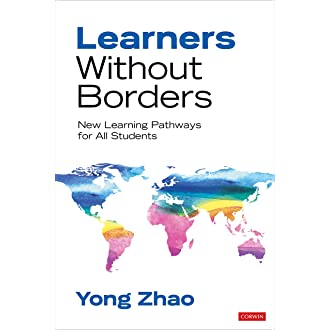
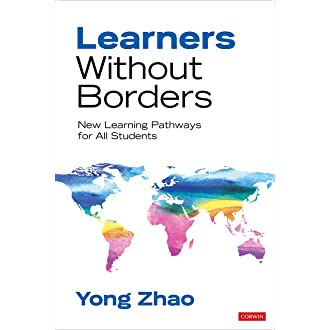
Learning Without Borders: New Learning Pathways for all Students by Yong Zhao
Erik Jahner, PhD
Erik Jahner, PhD

In Learning Without Borders: New Learning Pathways for all Students, Yong Zhao outlines an ongoing and necessary paradigm shift in education, offering new ways of thinking and examples from the frontier of this trend. This is a timely piece that highlights the changes that were forced upon us by the pandemic but have been in the works for a long time. The pandemic exacerbated existing cracks in the system but also spotlighted new opportunities. The old boundaries and structures of education need to be transformed if we truly want to create pathways for the success of all students.

This book asks us to fundamentally reorganize our thinking about school and to make it genuinely student-centered. Putting the student at the center of education is a relatively common idea in education, but Yong gives a contemporary angle enabling the reader to systematically build an understanding of emerging roles teachers and students will play in this new education. His book challenges the way we think about pedagogy by integrating discussions of learning pathways, curriculum design, self-directed learning, and existing technology.

At the core of the discussion is an education system that is built around student needs that are determined in partnership with students. But before we can challenge the practices of the system, flawed mindsets are challenged: schools do not prepare students for life — students are already living full lives full of formative experiences, and schools do not transmit knowledge to students — students have unprecedented access to knowledge and are learning all the time without direct instruction.

Along with a changing mindset comes a need for an evaluation of the paths we offer, schools do much more than prepare students for college. Schooling should dynamically align with the individual student pathways, not group students onto the same path. The current structured form of education focuses on curriculum design without students; to support student development, students need to be co-owners of curriculum design. The curriculum should support the students in following their passions and endeavors not in satisfying a list of government determined metrics. Learning needs to be meaningful and Yong helps us ask the right questions to direct our practice.

These changes are not only theoretical but are ready to implement now more than ever before. They are scaffolded by ripening technology that has enabled students to truly take the reins. This has led some to fear a replacement of teachers, but the challenge in education he [proposes is not how technology might replace teachers, but to understand what aspects of learning will be done through technology and what aspects have to be done directly by teachers. He helps the reader find their role in this shift by asking us to question our widely held beliefs and adopt new roles. Students have taken charge of their own learning and we as educators need to gain comfort and facility in acting as life coaches, resource curators, community leaders, and project managers. The challenge is to find the new emerging roles for teachers and students in this new educational ecology.

While Yong critiques ways of thinking he also challenges established and accepted norms. We have new types of students who are often enabled by technology engaging the world in new innovative ways. We are completely ignoring the student entrepreneur in our education approaches, for example. We send these students the message that school does not fit them rather than integrating their skills into the system. In another example, he points out structural flaws in student groupings. We currently ignore basic principles of development by grouping students by age not developmental level or passions. And while the classroom has been seen as a fundamental unit within a school, the new classrooms can span the globe. The book is filled with ideas that help us consider the development of current systems.

One may initially think such a book is only for the progressive school and the changes discussed are above the level of the teacher. However, the attentive reader will notice suggestions for small and large changes that teachers can make in their practice. It is not always about creating a new way, it is often about accepting and becoming aware of the ways that are already practiced in the world around us. Educators can use the principles outlined here to empower students, design classrooms, and engage in ways of practicing education that can affect change.

The crux of this argument is that the system is not addressing student needs and radical redesign is necessary to align with systems of learning that are already taking place.  This book helps the reader see and become part of a new education without borders.

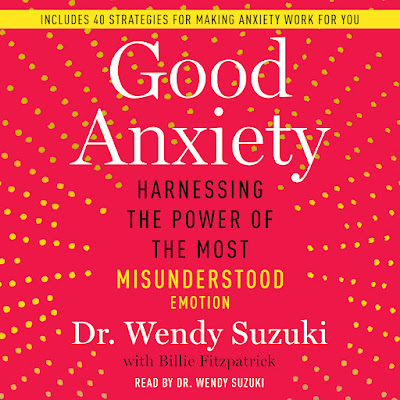
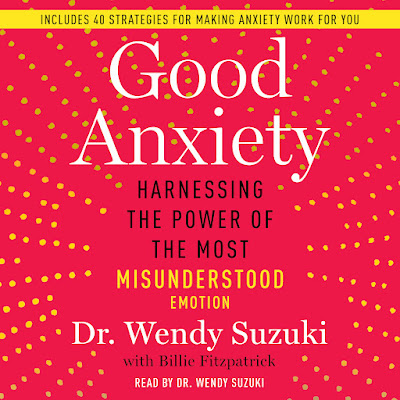
Good Anxiety: Harnessing the Power of the Most Misunderstood Emotion by Wendy Suzuki
Erik Jahner, PhD
Erik Jahner, PhD

Good Anxiety: Harnessing the Power of the Most Misunderstood Emotion takes a refreshing look at an emotional state, anxiety, that is often seen as a problem to be avoided and kept at bay; but here, Wendy Suzuki asks us to honor this aspect of our lives, understand it, and even embrace it. She asks that we interpret feelings of anxiety as useful indicators of the way we are framing contexts. We can use that information to adjust our perspectives so that anxiety can be a potential source of positive personal energy.

While emphasizing that anxiety falls along a spectrum, she does not minimize the clinical conditions of anxiety that are debilitating to the lives of many. Her descriptions are helpful heuristics to assist us in understanding what aspects of our anxiety may benefit from professional help. But, her approaches throughout the book may be applied anywhere along the spectrum from these severe situations to everyday anxieties. The framing of our events that lead to anxiety is flexible and can be tweaked offering us a reprieve from the perpetual anticipation of what could go wrong and even pave the way toward a more actualized self.

As educators our focus is too often on getting through a long list of endless tasks: grading, preparing, going to meetings, attending to parents, and of course still mindfully attending to students. But all these tasks bring with them some degree of uncertainty and anxiety: Will I get it done? What will they think? Do I know how to run a zoom call? Am I doing my job effectively? But we still push through, dismissing these emotions in favor of checking off another task as done. We imagine that getting tasks done will make us feel better, but things are never really ‘done.’

Suzuki recognizes that while we all experience anxiety, we seldom take the time to engage the emotion and give it the respect it deserves. Ignoring anxiety does not make it go away; it compounds until we fight, flee, or freeze – are we attending to these adaptive responses that tell us something is wrong? Even a persistent low level of anxiety has deleterious effects on our body and mind. If we do not respect anxiety, we virtually guarantee that we will not be performing at our best which can further drive rumination and further deleterious anxiety. This book is a guide on a journey to building a healthier relationship with our anxiety and incorporating our knowledge into our lives for our benefit.

Through her engaging and scientifically accurate descriptions of the physiological processes, she helps us see anxiety as a biological system that has evolved for our protection but is flexibly under our influence. Bringing together an array of up-to-date research, she integrates the neuropsychology of both top-down and bottom-up processes into a set of practices that allow us to take advantage of the neuroplasticity of the system: relaxing the body, calming the mind, redirecting and reappraising, monitoring responses, and learning to tolerate the uncomfortable.

Authentic personal and third-person narratives illustrate the lessons in this book in an accessible and engaging way. You will see yourself in the various scenarios having made similar choices increasing your understanding of your past and future actions, but also giving you insight into the actions of others, helping improve our lives and the lives of our students. The narratives clearly illustrate how, when harnessed, anxiety may help you achieve your goals if you listen and engage this emotion appropriately.

The final portion of the book gives us some valuable assessment tools to help us gain a more mindful awareness of our mental state. Reading this book gently brings anxieties into view, affording us the opportunity during its reading to work with our anxiety. These assessment tools take us full circle back to the contents of the book and the menu of strategies we can draw from to address our evolving processing of anxiety.

Over the last few years, but not isolated to them, anxiety has been on the rise: the pandemic, elections, tense race relations, changing political landscapes, and further global catastrophes. This barrage is complemented by our unfortunate practice of ‘doom scrolling’ generating a feedback loop that seems like an endless drive toward harmful anxiety. What will the world throw at me next, and will I be able to cope? Students, parents, and teachers are doing their best to work through this moment, but we have been ill-equipped. When reading this book, fill it with sticky notes and bookmarks encouraging a return to strategies for checking, evaluating, and adapting your relationship with anxiety. Suzuki offers a useful tool to help us all on the road to recovery and prepare our minds and bodies for challenges yet unknown.