

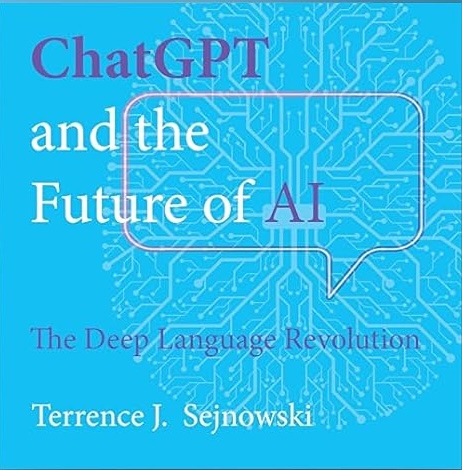
Every semester, a few essays arrive so polished they almost sparkle, but they do so with visceral discomfort—like a poorly animated movie too close to reality but not quite there. Graceful syntax, perfect grammar, not a single false note—and somehow, no soul. That uncanny smoothness feels less like a student voice and more like the hum of a machine operating in the “uncanny valley.” Terrence Sejnowski positions ChatGPT and the Future of AI—The Deep Language Revolution right there, in that uneasy space between fluency and understanding.
Sejnowski isn’t an outsider gazing at the AI spectacle; he’s one of its architects. A pioneer of computational neuroscience and deep learning, he helped lay the foundations that made ChatGPT possible. This book extends his earlier Deep Learning Revolution into a new frontier—the “deep language” era, where machines have not only learned to recognize patterns but to converse with us in our own language, feeling like a new friend.
What makes this volume distinctive is its method. Sejnowski doesn’t simply describe large language models (LLMs); he talks with them. Throughout the text, unedited AI dialogues appear as miniature laboratories—moments where he prods a model, exposes a glitch, or lets it surprise him. These exchanges give the book an experimental rhythm, turning abstract theory into lived conversation. It’s storytelling through inquiry: part lecture, part dialogue, part field report from the edge of cognition.
At its heart, the book asks how we might live with LLMs rather than fear or worship them. The “deep” in Sejnowski’s title refers both to the neural architectures driving these systems and to their deepening impact on human culture. The early chapters read like a chronicle of adaptation—teachers revising curricula, programmers gaining new copilots, writers negotiating inspiration and imitation. He captures the dawning normalcy of a world where thinking now includes a digital partner. He also addresses the ethics of actor, artist, and writer replacement.
Sejnowski’s tone is what makes the technical accessible. When he explains transformers—the attention-based models at AI’s core—he does so with the warmth of a teacher, using metaphor rather than jargon. He reminds us that prompting a model resembles prompting a student: clarity, tone, and curiosity determine the quality of response.
His insights land close to home. In my own classroom, I have regularly used ChatGPT as a thinking coach—a partner for brainstorming, counter-arguing, and reflection. But my students must practice prompt literacy: learning to frame, question, and verify. The reality is they compete in a world where AI is the new baseline, and they need to determine what more they can add. The goal isn’t to outsource thinking but to observe it more closely.
As the book progresses, Sejnowski tightens the lens. He unpacks the mathematics of attention, scaling laws, and embedding with clarity, then widens again to ask what this means for work, education, and the mind itself. His tone is steady—curious, not alarmed. If the Industrial Revolution amplified muscle, he writes, this one amplifies mind. The challenge is adaptation, not extinction. There’s an echo of Vygotsky here: language, whether human or machine-generated, becomes a tool of thought, extending cognition beyond the skull.
He’s careful, too, about risk: hallucination, bias, misplaced trust. His solution is epistemic rather than technical—verification as a daily habit, curiosity as our best defense. The danger isn’t deception from machines but complacency in ourselves. AI can extend the mind, but only if we resist the temptation to let it stand in for one.
Stylistically, Sejnowski writes like a scientist who enjoys teaching. The book moves from conversational to analytic to philosophical, mirroring the dialogue he champions and instigating discussion. The AI transcripts punctuate the text with moments of surprise, proof that discovery often begins with a question.
For educators, this book is essential reading to stay updated with the developing and culturally embedded mind. For those drawn to cognitive science or the inner workings of language models, it offers a rare synthesis of neuroscience, computation, and pedagogy. Even readers who’ve followed every AI headline will find something new here: a deeper understanding of how these systems “think,” and what that reveals about how we do.
Sejnowski ends with quiet but unmistakable optimism. The revolution he maps is one of shared cognition—language itself becoming a bridge between human and machine minds. For teachers, researchers, and anyone studying how thought extends beyond the individual, this book is both a compass and a challenge: to stay curious, critical, and conversational at the edge of intelligence.