
classroom advice – Page 4 – Education & Teacher Conferences Skip to main content
Starting Class with “Prequestions”: Benefits, Problems, Solutions
Andrew Watson
Andrew Watson

We’ve known for many years now that retrieval practice works.

Hispanic student wearing a blue shirt raising his hand to ask a question in class

That is: after we have introduced students to a topic, we might REVIEW it with them the next day. However, they’ll remember it better if we ask them to try to RETRIEVE ideas and procedures about it.

As Dr. Pooja Agarwal and Patrice Bain write, we want students to “pull information out of their brains” (retrieve) not “put information back into their brains” (review).

Sadly, we know that students’ intuition contradicts this guidance. They really want to reread or review their notes, rather than ask themselves questions.

In this (very sad) study, for instance, Dr. Nate Kornell and Dr. Lisa Son found that students think review works better than retrieval even when they do better on quizzes following retrieval!

Yes, even the experience of learning more doesn’t persuade students that they learned more.

YIKES.

The More Things Change…

Let’s take this retrieval practice idea one step further.

I wrote above that answering questions helps students learn AFTER they have been introduced to a topic.

But: does answering questions help students learn a topic even BEFORE they study it?

On the one hand, this suggestion sounds very strange. Students can’t get these “prequestions” right, because they haven’t yet studied the topic.

On the other hand, we’ve got research showing that this strategy works!

In one of my favorite studies ever, Dr. Lindsay Richland found that “prequestions” help students learn. And, she then worked really hard to disprove her own findings. When she couldn’t explain away her conclusions, she finally accepted them. *

Similarly, a more recent study suggests that learning objectives framed as questions (“Where are mirror neurons located?”) helps students learn more than LOs framed as statements (“You will learn where mirror neurons are located.”).

Although this prequestion strategy hasn’t been studied as much as retrieval practice, I do think it has enough research behind it to merit teachers’ respectful attention.

However, I do think this approach has a practical classroom problem…

Sustaining Motivation

For the most part, my high-school students are an amiable lot. If I ask them to do something … say, answer retrieval practice questions … they’ll give it a go.

And, they almost certainly want to get those questions right.

In a class discussion about Their Eyes Were Watching God, for instance, we might compare Janie’s three “husbands.” If I ask a student the following day to list some points of comparison from memory (retrieval practice!), they’ll feel that they ought to remember an answer or two.

Let’s try this logic with prequestioning.

Imagine I ask my students this prequestion: “Why do you think the novel’s protagonist will have the nickname ‘Alphabet’?”

My students will gamely try some answers.

However, I worry that – over time – they’ll start losing interest.

They almost never get these answers right.

And, there’s no “penalty” for getting them wrong, or reward for getting them right. (We don’t want students to focus on rewards and penalties, but schools typically work this way…)

From the student perspective, in other words, the whole prequestion strategy feels like an exercise in futility.

Why should they bother to think seriously about these un-answerable questions? They feel like wasted mental effort…

Two Solutions

First: I’ve tried in the past to solve this problem by using the strategy infrequently.

If my students don’t experience this quirky frustration too often, I hope, they won’t mind participating in this odd ritual.

Recent research, however, offers a second solution – a more honorable solution than mine.

In this study, by Dr. Steven Pan and Dr. Michelle Rivers, prequestions consistently helped students learn.

However, students didn’t really notice the benefit of prequestions – even when they learned more from answering them. (This result sounds a lot like the Kornell and Son study about retrieval practice; students don’t register the benefits they experience.)

So, Pan and Rivers tried several solutions. Specifically, they found benefits to a multi-step approach:

Step 1: have students learn some info with prequestions, and some without.

Step 2: give them a no-stakes quiz on the info.

Step 3: let them see that they remembered information better after prequestions.

Step 4: next time, ask students to recall how well they remembered after answering prequestions.

In other words: students need to experience the benefits and to have them repeatedly pointed out. This combination, probably, helps students believe that prequestions really do help.

This insight (probably?) helps with the motivation problem that has been troubling me in the past.

In other words: students who believe that prequestions will help are much likelier to participate in the curious mental exercise of trying to answer questions whose answer they can’t yet know.

TL;DR

When students answer questions about information they’re about to learn, they remember that information better – even if they get the answers wrong.

This strategy might be effective in the short term, but hamper motivation over time. After all, why should students even try to answer questions if they’re unlikely to know the answer?

To counteract this motivational problem, take students through Pan & Rivers’s procedure for them to experience and remember the benefits that prequestions provide.

We don’t have LOTS of research on this strategy, but we do have enough to make it a plausible approach.


* Sadly, the “prequestion” strategy has frequently been called “pretesting.” Of course, the presence of the stem “test” both confuses the strategy (there’s no testing!) and disinclines people from participating (who wants more testing?).

So, let me emphasize: “prequestions” are simply questions. They’re not a test.

BTW: I’ve recently seen the word “pretrieval” as a way to avoid the “pretest” moniker. You might like it better than “prequestions.”


Agarwal, P. K., & Bain, P. M. (2019). Powerful teaching: Unleash the science of learning. John Wiley & Sons.

Kornell, N., & Son, L. K. (2009). Learners’ choices and beliefs about self-testing. Memory17(5), 493-501.

Pan, S. C., & Rivers, M. L. (2023). Metacognitive awareness of the pretesting effect improves with self-regulation support. Memory & Cognition, 1-20.

Richland, L. E., Kornell, N., & Kao, L. S. (2009). The pretesting effect: Do unsuccessful retrieval attempts enhance learning?. Journal of Experimental Psychology: Applied15(3), 243.

Sana, F., Forrin, N. D., Sharma, M., Dubljevic, T., Ho, P., Jalil, E., & Kim, J. A. (2020). Optimizing the efficacy of learning objectives through pretests. CBE—Life Sciences Education19(3), ar43.

The Hidden Lives of Learners
Andrew Watson
Andrew Watson

Many times over the last several years, I’ve heard enthusiastic reviews of a seemingly-magical book called The Hidden Lives of Learners, by Graham Nuthall.

Book Cover for The Hidden Lives of Learners by Graham Nuthall. The cover shows a mountain range in front of a blue and cloudy sky.

Here’s the magic: Nuthall’s frankly astonishing research method.

Working in New Zealand classrooms in the 1980s, he put mics on all students and teachers. And, he had cameras in the classroom.

He and his team also broke down the teachers’ unit plans into granular learning goals. For instance, a unit on Antarctica might have 80 specific facts or concepts that the students should learn.

Finally, Nuthall’s team tested students both before and after these units.

Given this quite extraordinary data set, Team Nuthall could look at remarkably specific questions:

How much information about each topic did students already know before the unit began?

How much did they learn?

What, very specifically, did each student do and say to learn each specific new concept?

You can see why readers have responded so strongly to Nuthall’s method.

So, based on all his data, what did Nuthall conclude?

The Magic Number

Regular blog readers already know about the Spacing Effect.

That is: students learn more when they spread practice out than when they do the same amount of practice all at once.

In my experience, this research finding started getting broader notice in … say … 2015 or so. (I completed my grad program in 2012, and I don’t remember the spacing effect getting much — or any — attention at that time.)

Well, Nuthall’s research led him to a very similar conclusion more than a decade before.

That is: in Hidden Lives, Nuthall writes…

We discovered that a student needed to encounter, on at least three different occasions, the complete set of the information she or he neede to understand a concept.

If the information was incomplete, or not experienced on three different occasions, the student did not learn the concept. (63)

Similar to research into the spacing effect, Nuthall’s research shows that students must devote brain space to an idea several times — spread out over more than one class meeting — to consolidate that idea in long-term memory.

Later in Hidden Lives (p. 126), Nuthall suggests that students should “encounter the complete set of information” on four occassions — not three.

For me, the precise number (is it 4? is it 3?) is less important than the broader concept: teachers should build curricula that ensure students delve into an idea several times. One or two encounters can’t create enough momentum to change memory systems.

I think that Nuthall’s method provides substantial support for translating the spacing effect research into classroom practice. Both psychology research AND Nuthall’s deep classroom investigation arrive independently at substantially similar ideas.

Changing the Focus

Most research in this field focuses on what teachers do. Nuthall — wisely — insists that we focus on what students do.

His methodology — all those microphones, all those transcripts — helps him recognize all those “encounters” with ideas. And, crucially, students often “encounter” ideas in their conversations and projects with other students.

This observation leads to several important insights.

First, students often have prior knowledge about a topic.

When that prior knowledge is incorrect, it BOTH hinders their understanding of new ideas AND hampers their classmates’ efforts to learn correct ideas.

For this reason — I’m extrapolating from Nuthall here — teachers really should focus on students’ prior misconceptions.

Unless we know what our students (wrongly) think they know, their misinformation will substantially muddle the learning process.

Second, building classroom culture matters.

This seemingly obvious statement comes from one of Nuthall’s most alarming findings (well: alarming to me).

The students in these classes were AMAZINGLY unkind to one another. Casual insults — even racial epithets — made up a regular part of classroom dialogue.

Nuthall proposes two solutions to this problem.

Option A: “Teachers therefore need to know who is in which friendship groups, who wants to be liked by whom, who has status, who is rejected.

They also need to know the kinds of beliefs and culture — about music, clothes, curriculum, learning, co-operating, and the like — that hold students’ relationships together.” (p. 37)

While I understand the logic behind this statement, it strikes me as frankly impossible. As I think over my various sophomore and senior English classes, it’s simply inconceivable to me that I would know — with any level of consistent detail — what the exact relationships are among all these people.

I might have a dim idea that this student is especially popular, or that those two are dating, or that some song or another has everyone’s attention. But for that knowledge to be broad and current: no way.

In fact, I think it would be inappropriate for me to know such things. Inquiring too closely into students’ personal and romantic lives does not strike me as healthy or appropriate.

A Better Way?

Happily, Nuthall proposes Option B:

“Some teachers have tried to deal with this problem [peer-to-peer unkindness] by creating an alternative culture within their classrooms — a culture of mutual respect and cooperation, a culture in which everyone is expected to succeed in some significant aspect of classroom activities.” (p. 37)

Now, this approach seems healthy, appropriate, and necessary.

Yes, I want my students to learn about Macbeth and topic sentences, but I also insist that they know how to treat one another well.

Nuthall’s findings about casual peer cruelty has reminded me how much happens in my classroom that I can’t see (“hidden lives of learners”), and how important it is that I solve those invisible problems.

The Very Big Picture

One final point stood out for me in Nuthall’s book, although my interpretation of it might not persuade you. Here’s the story…

Because Nuthall measured how much students already knew, and what they did to learn new information, he could track important patterns. One pattern went like this:

Students who didn’t know much about the topic learned most from the teacher.

Students who already knew a lot learned most by working on their own, or with peers. (pp. 86-7)

I think this finding might help us see past a controvesial binary in the field of education.

Current schooling debates have encouraged us to pick sides. Either we believe in direct instruction, or we believe in project pedagogies. (This sentence oversimplifies a very complex debate, but is a useful shorthand at this moment.)

Nuthall’s findings (and my own reading of schema theory) suggest an alternative viewpoint. Perhaps

Students who don’t know much about a topic (a.k.a. “novices”) learn most from the teacher (a.k.a. “direct instruction”), whereas

Students who already know a lot (a.k.a. “relative experts”) learn most by working on their own, or with peers (a.k.a. “project pedagogies”).

That is: before we say whether direct instruction or independent investigation is better for a student, we have to know where the student lies on the novice/expert continuum.

Novices need lots of guidance; relative experts benefit from more open-ended, self-driven exploration.

To be clear: I’ve been quietly advocating for this view for a few years now. It seems to me — although I could be wrong — that Nuthall’s data roughly support it.

Read This Book If…

…You’re intrigued by the possibility of extremely granular classroom research, focusing directly on the students’ experience,

…you want to see how the spacing effect plays out in the classroom,

…perhaps you want to know more about how students actually treat each other in day-to-day interactions.

…you want to hear an inventive and thoughtful researcher think aloud about his findings.

I don’t agree with everything that Nuthall has written. For instance, his account of working memory is not at all in line with current models of this cognitive function.

But, gosh: he and his book have given me lots to think about, and new ways to think about old ideas.

The Most Important 5 Minutes in Class: The Primacy/Recency Effect
Andrew Watson
Andrew Watson

As we put our lesson plans together, we teachers want to know: are some minutes more valuable than others?

Student Holding Clock

That is:

Do students remember most at the 10-minute mark of the lesson, because they’re mentally revved up?

Or, perhaps they remember most from the final five minutes, because the whole class has led to this grand conclusion.

Or, perhaps some other time slot generates the most learning, because psychology reasons.

What does the research tell us?

Start Here

I occasionally see teaching advice that seeks to answer this question. That advice typically begins with a fascinating research pool.

Here’s the story.

Researchers present students with — say — a list of 15 words. After distraction, how many  words do students remember? And, can we predict which ones?

Several studies suggest a consistent answer.

Students tend to remember words from the beginning of the list. Researchers call that the “primacy” effect.

And, they remember words from the end of the list. That result gets the moniker “recency effect.”

Going all the way back to 1962, this primacy/recency effect has a lot of research behind it. (For a more recent study, click here.)

Lab to Classroom

So, how should teachers plan our lessons based on this particular finding?

Let’s imagine that I tell my students a list of 8 instructions. Because of the primacy/recency effect, I suspect they’ll remember the early and late instructionst better than the ones in the middle. (Hint: maybe I should write down a long list of instructions…)

But: what does this effect tell us about the most valuable teaching time during a class period as a whole?

From time to time, scholars who translate psychology research for classroom teachers make this argument:

The primacy/recency effect suggests that the first several minutes of class, and the final several minutes of class, have the greatest effect on learning.

That is: For the same reason that students remember the first and last instruction from my list of 8, they’ll learn the most during the first and last minutes of class.

Voila: a research-based answer to the question.

I confess, however, that I myself have doubts.

The argument says, in effect:

Rules governing mental processes for 60-120 seconds also govern mental processes for 45-80 minutes.

Honestly, I’m just not sure that’s plausible. My doubts spring from two sources.

Doubts, and More Doubts

In the first place, I doubt this advice because it extrapolates so far beyond the initial research conditions.

If research tells me something about — say — college students, that conclusion might also apply to 1st graders. But it might not. 1st graders aren’t college students.

If research tells me something about adolescents in Iceland, that conclusion might apply to teens in Brazil. But it might not. Icelandic culture differs from Brazilian culture.

And, if research tells me about mental functions over one minute, that conclusion might apply to 20 minutes. (Or 45, or 80.) But IT MIGHT NOT. One minute isn’t twenty.

Long-time readers know I always focus on “boundary conditions.” From my perspective, this advice goes WAY beyond the boundaries of the initial research.

By the way: I’ve asked SEVERAL wise people if they know of primacy/recency research that goes beyond a minute or two. So far, the answer is “no.”

The second reason I doubt this advice because of the specific mental functions involved.

As far as I can tell, researchers explain the primacy/recency effect by talking about short-term memory and working memory.

Both of these mental faculties describe very short-term mental functions. In my grad-school classes, our profs typically said that working memory holds information somewhere between 5 and 30 seconds.

If, in fact, the primacy/recency effect results from short-term and working memory functions, then those findings almost certainly won’t apply to mental processes that take 30+ minutes.

Like, say, our classes.

Just Answer the Question

If this advice doesn’t hold, what can research tell us about the “most important five minutes in class”?

I’ve got two answers.

Answer #1:

I’ve asked lots of people if they have a resaerch-informed answer to this question. So far, no one has a strong “yes.” But, If I hear of one, I’ll pass it along.

And, btw, a friend has answered “we really have to research that question!” So, I’ll let you know if/when his results come through.

Answer #2:

Long-time readers know my mantra: “don’t just do this thing; instead, think this way.”

In this case, I don’t think we can plausibly identify any one time slot that consistently generates the most learning.

Instead, we want to use core ideas from cognitive science to structure lesson plans effectively.

Use retriveal practice.

Beware working-memory overload.

Foster attention.

Activate prior knowledge.

And so forth.

If we follow this approach, every minute will build ultimately — and more-or-less equally — toward students’ learning.


Castel, A. D. (2008). Metacognition and learning about primacy and recency effects in free recall: The utilization of intrinsic and extrinsic cues when making judgments of learning. Memory & Cognition36(2), 429-437.

“No Cameras Allowed:” Does Taking Pictures During Lectures Benefit Learning?
Andrew Watson
Andrew Watson

Should students use cameras to take pictures of boardwork?

My high school students know my fierce anti-cell-phone policy. Nonetheless, they do occasionally ask if they may take a quick picture. (I typically say yes, and then check to be sure the phone goes back in the bag.)

When I do PD work at schools, or present at conferences, teachers take pictures of my slides ALL THE TIME.

Of course, the fact that students and teachers want to take those pictures doesn’t automatically mean that it’s a good idea to do so.

In fact, we have several reasons to think it’s a bad idea.

First reason: those photos might serve as subtle hint to our brain’s memory systems: “you don’t need to remember this, because you’ve got a photo.”

Second reason: the act of taking a photo might distract students (and teachers) from the content we’re discussing.

For example: If my students are thinking about framing the photo correctly (and using a cool filter), they’re NOT thinking about the ways that Fences combines both comic and tragic symbols.

Third reason: we’ve got research!

Check this out…

Prior Knowledge

Researchers have looked at this question for several years now.

In several studies, for instance, researchers asked participants to tour a museum and take pictures of various works of art.

Sure enough, later tests revealed that people remember more about the artwork they didn’t photograph than the artwork they did photograph.

As predicted above, something about taking a photograph made it harder – not easier – to remember the content.

For all these reasons, it seems, teachers might reasonably discourage students from taking photos.

At the same time, we should probably keep asking questions.

In particular, we should acknowledge that museum photography probably isn’t a good stand-in for classroom photography.

That is: my students (and teachers during PD) probably take photographs to help themselves remember important ideas, concepts, and examples. In museums, people might take pictures because that statue is so cool and beautiful!

The museum research offers a useful and interesting baseline, but we’d love some research into … say … actual classrooms.

Cheesemaking, and Beyond!

Well, I’ve got good news. A research team — led by Dr. Annie Ditta at the University of California, Riverside — has indeed started exploring exactly these questions.

In their studies, Team Ditta had students watch 3 short online video lectures about obscure topics. (Like, cheesemaking. No, I’m not joking.)

Participants took pictures of half of the slides.

Here’s the primary question: did students remember more information from the photographed slides, or the unphotographed slides?

SURPRISE! Taking pictures helped students remember the information on the slide.

For the reasons listed above, I did not expect that result. In fact, the researchers didn’t either.

But, those photos really helped.

In one study, students got 39% of the questions right for the slides they photographed, and 29% right for the ones they didn’t. (Stats folks: Cohen’s d was 0.41.)

Given how EASY this strategy is, we should really pay attention to this finding.

By the way, Dr. Ditta’s study explored some other questions as well.

First: students remembered info from photographed slides better both when they decided which slides to photograph and when they were told which ones to photograph.

So, if we tell students to “photograph this information,” we (probably) don’t disrupt the benefit.

Second: what about spoken information?

Common sense suggests that taking a picture won’t help remember spoken ideas (if those ideas aren’t written on the slide). In fact, taking that picture might distract students from the spoken words.

Strangely, in this research, Team Ditta came up with mixed – and surprising – results. In one study, taking a picture made no difference in memory of spoken material. In the other, it benefitted memory of spoken material.

WOW.

So, What Should Teachers Do?

Before we rush to apply research in our classrooms, we always want to ask a few questions.

In this case, I think we should have LOTS of questions.

First: Dr. Ditta’s research looked at brief, online lectures for college students.

Do these conclusions apply to longer classes? To in-person classes? For K-12 students? To students who aren’t neurotypical?

We just don’t (yet) know.

Second: participants in these studies didn’t do anything with the photos. They simply took them.

Would we find the same pattern for students who reviewed their photos, compared to – say – reviewing their notes?

We don’t (yet) know.

Third: participants were tested on their knowledge 5 minutes after the videos were done.

We’ve got LOTS of research showing that short-term gains don’t necessarily result in long-term learning.

So, would these findings hold a week later? A month later?

We don’t (yet) know.


Given all the things we don’t know, how can this research benefit us?

For me, these studies open up new possibilities.

In the past, as I described above, I permitted students (and teachers) to take photos. But I tried to discourage them.

I would even – on occasion – explain all the reasons above why I thought taking photos would reduce learning.

Well, I’m no longer going to discourage.

Instead, I’ll explain the complex possibilities.

Perhaps taking photos helps memory because it signals that THIS INFORMATION DESERVES ATTENTION.

Or, perhaps taking photos helps only if students DON’T review before tests. But, taking notes would help more … especially the students who DO review before tests.

And perhaps, just perhaps, this research team got flukey results because even well-done research sometimes produces flukey results. Future classroom research about taking photos of slides might ultimately suggest that (despite this thoughtful work), it really is a bad idea.

I wish the answer were simpler, but it just isn’t.

TL;DR

Surprising new research suggests that taking photos of lecture slides helps college students remember slide contents – even when students don’t review those photos.

Before we teachers rush to make dramatic changes, we should think carefully how this research fits our classrooms and contexts.

And, we should weigh this memory strategy against lots of other strategies – like retrieval practice.

Finally: let’s all watch this space!


Ditta, A. S., Soares, J. S., & Storm, B. C. (2022). What happens to memory for lecture content when students take photos of the lecture slides?. Journal of Applied Research in Memory and Cognition.

Soderstrom, N. C., & Bjork, R. A. (2015). Learning versus performance: An integrative review. Perspectives on Psychological Science10(2), 176-199.


How Students (Think They) Learn: The Plusses and Minuses of “Interleaving”
Andrew Watson
Andrew Watson

As the school year begins, teachers want to know: can mind/brain research give us strategies to foster learning?

We might also wonder: what will our students think of those strategies?

College Students Sitting in Hallway

It seems plausible — even likely — that students will prefer the strategies that help them learn. If those strategies help, why wouldn’t students like them?

Strategies to Foster Learning

Some classroom truths seem almost to basic to say out loud. For instance:

#1: We want our students to learn several different sub-topics within any particular topic.

And

#2: Students need to practice to learn.

When teachers think about those basic truths at the same time, we often adopt a specific strategy.

We ask students to practice (that’s #2) each individual subtopic (that’s#1) on its own. So:

Students practice identifying nouns, and then they practice identifying verbs, and then the practice identifying adjectives.

Or, angles, then circumferences, then areas.

Or, backhand, then forehand, then serve.

We could represent this strategy this way: AAA, BBB, CCC. Each sub-topic gets its own discrete practice session.

But, would a different strategy be better? How about: ABC, CBA, BCA?

In other words: should students jumble different topics together when they practice?

Interleaving: Old Research, and New

The answer to that question is YES: students SHOULD jumble different sub-topics together when they practice.

For research confirmation, you can check out this study by Rohrer and Pashler.

Or, for a broader synthesis, explore Agarwal and Bain’s great book, Powerful Teaching.

Or, you might ask a pointed question: “has this strategy been tested in actual classrooms, not just in psychology research labs?”

The answer to that question is also YES.

recently published study by Samani and Pan tried this strategy in a college physics class.

Sure enough, students learned more when their homework problems were interleaved than when sub-topics were practiced one at a time.

That is: students whose practice problems covered Coulomb’s Law by itself learned less than those whose practice problems also included capacitors and composite wires.

So, we arrive at this tentative teaching advice:

No doubt, you have your students practice — either in class, or with homework, or both.

When students practice, they should work on a few sub-topics at a time, not just one.

So far, so good.

Paradox: Teaching Solutions Create Studying Problems

Let’s return to the question that opened this blog post: do students prefer the study strategy that fosters learning. (They should; after all, it helped them learn!)

Reader, they do not.

Why?

In Samani and Pan’s study (and many others), students found that effective learning strategies are more difficult.

That is: they require more thought, and frequently lead to more short-term mistakes. (Students did relatively badly on the homework before they did relatively well on the tests.)

From one perspective, this finding makes perfect sense.

If we do difficult mental work, we will struggle and fail more often. And yet, all that extra hard thinking will ultimately lead to more learning. (Soderstrom and Bjork have written a GREAT review article on this topic.)

That encouraging perspective, however, runs into a perfectly understandable alternative: most people don’t like struggle and failure.

We shouldn’t blame students for disliking the interleaving. It hurt their heads. They did badly on the homework. YUCK.

As teachers, we have the long-term perspective. We know that short-term struggle leads ultimately to greater learning.

But, most students lack that perspective. They feel the struggle and the pain, but don’t recognize the long-term benefits.

Teaching Advice 2.0

Given all these findings, how should we structure students’ practice?

I think all these findings add up to this guidance:

First: interleave practice.

Second: tell students that you are doing so, and explain why.

The language you use and the level of explanation will, of course, vary by the age of the student. But, let them know.

Third: structure grading systems to value ultimate learning more than immediate understanding.

After all, if we both require interleaved practice (which is quite difficult) and grade students on the success of their practice, we will — in effect — force them to have lower grades. They will rightly feel the injustice of this instructional paradigm.

In other words: this practice strategy — in my view — does imply a grading policy as well.

TL;DR

Students, of course, must practice to learn.

Teachers should structure their practice to cover a few sub-topics simultaneously.

We should explain why we’re doing so; “interleaving” ultimately results in more learning.

We should create grading structures that account for the initial difficulty of interleaved practice.

If we get this balance right, students will willingly face early learning challenges, and ultimately learn more.


Rohrer, D., & Pashler, H. (2010). Recent research on human learning challenges conventional instructional strategies. Educational Researcher39(5), 406-412.

Agarwal, P. K., & Bain, P. M. (2019). Powerful teaching: Unleash the science of learning. John Wiley & Sons.

Samani, J., & Pan, S. C. (2021). Interleaved practice enhances memory and problem-solving ability in undergraduate physics. NPJ science of learning6(1), 1-11.

Soderstrom, N. C., & Bjork, R. A. (2015). Learning versus performance: An integrative review. Perspectives on Psychological Science10(2), 176-199.

The Best Book on Cognitive Load Theory: Ollie Lovell to the Rescue
Andrew Watson
Andrew Watson

Teaching ought to be easy.

After all, we have a functionally infinite amount of long-term memory. You don’t have to forget one thing to learn another thing — really.

So: I should be able to shovel information and skills into your infinite long-term memory. Voila! You’d know everything

Alas, to get to your long-term memory, “information and skills” have to pass through your working memory. This very narrow bottleneck makes learning terribly difficult — as teachers and students well know.

If only someone would come up with a theory to explain this bottleneck. If only that theory would help teachers and students succeed despite its narrow confines.

Good News, with a Twist

Happily, that theory exists. It’s called “cognitive load theory,” and several scholars in Australia (led by John Sweller) have been developing it for a few decades now.

It explains the relationship between infinite long-term memory and limited working memory. It explores practical classroom strategies to solve the problems created by this relationship.

Heck, it even muses upon evolutionary explanations for some quirky exceptions to its rules.

In other words, it has almost everything a teacher could want.

Alas — [warning: controversial opinion] — it does include one glaring difficulty.

Cognitive load theory helps educational psychologists talk with other educational psychologists about these topics.

However, it relies on on a long list of terms, each of which describes complex — sometimes counter-intuitive — concepts.

If you start reading articles based on cognitive load theory, you might well discover that …

… a particular teaching practice works this way because of the “split attention effect” (which doesn’t mean exactly what it sounds like),

… but it works that way because of the “expertise reversal effect,”

… and “element interactivity” might explain these contradictory results.

For this reason, paradoxically, teachers who try to understand and apply cognitive load theory often experience cognitive overload.

As a result, teachers would really benefit from a book that explains cognitive load theory so clearly as not to overwhelm our working memory.

Could such a book exist?

Ollie Lovell To The Rescue

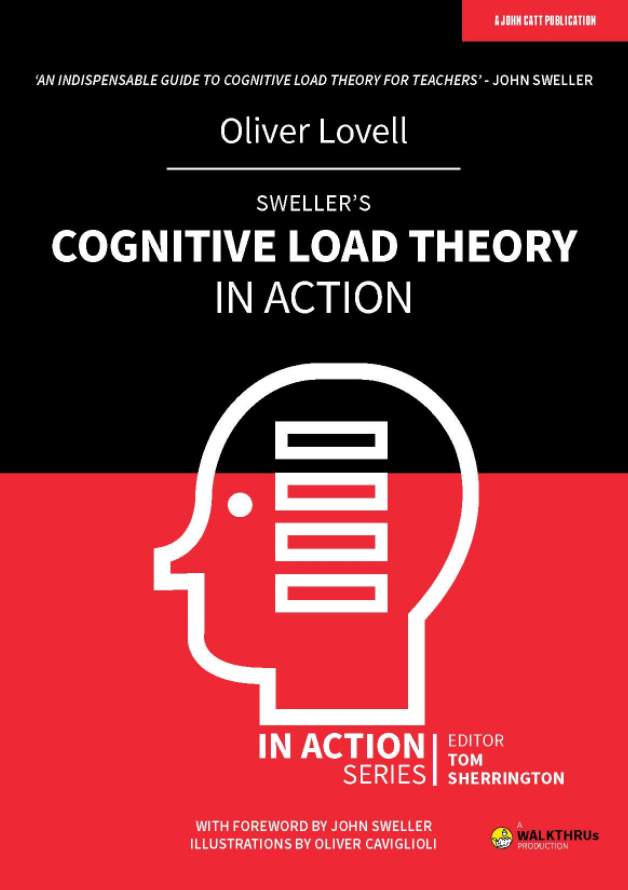
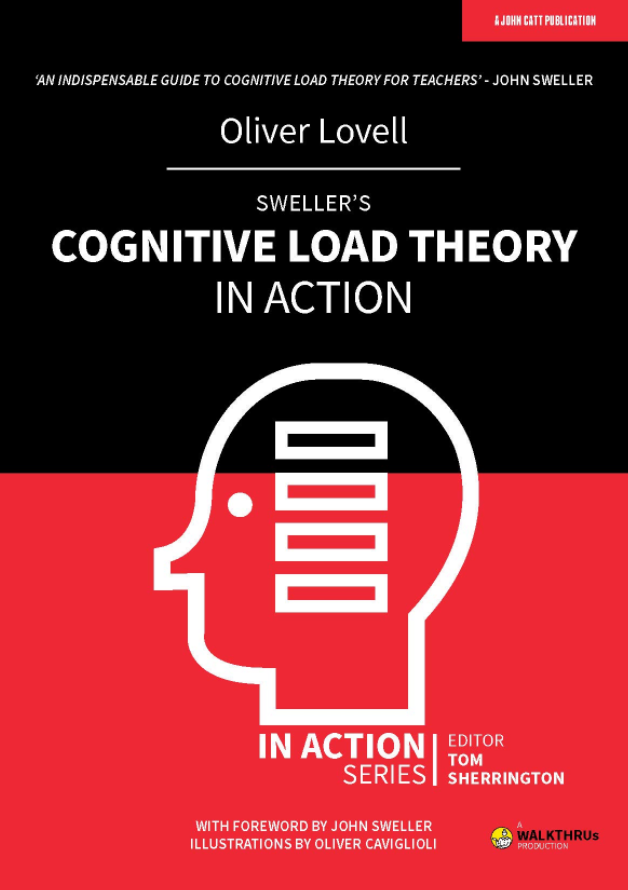
Yes, reader, it exists. Oliver Lovell has written Sweller’s Cognitive Load Theory In Action (as part of Tom Sherrington’s “In Action” series).

Lovell’s book does exactly what teachers want it to do: explain cognitive load theory without overloading our cognitive faculties.

Lovell accomplishes this feat with three strategies.

First, he has an impressive ability to explain cognitive load theory concepts with bracing clarity.

For instance, let’s go back to that “expertise reversal effect.” Why might a teaching strategy benefit a novice but not an expert?

Lovell’s answer: redundancy. Redundant information taxes working memory. And, crucially:

“What is redundant for an expert is not redundant for the novice, and instructional recommendations are reversed accordingly.”

That’s the “expertise reversal effect.” Pithy, clear, sensible.

Because he writes and explains so clearly, Lovell helps teachers understand all that cognitive load theory terminology without feeling overwhelmed.

Second, Lovell gives examples.

SO MANY CLASSROOM EXAMPLES.

Whatever grade you teach, whatever topic you teach, you’ll find your discipline, your grade, and your interests represented. (I believe Lovell is a math teacher; as a high-school English teacher, I never felt slighted or ignored.)

Geography, piano, computer programming. It’s all there.

Knowing that clear explanations of worked examples can reduce working memory load, he provides plenty.

Practicing What He Preaches

Third, Lovell simplifies needless complexities.

Students of cognitive load theory will notice that he more-or-less skips over “germane” cognitive load: a category that has (ironically) created all sorts of “extraneous” working memory load for people trying to understand the theory.

He describes the difference between biologically primary and biologically secondary learning. And he explains the potential benefits this theory offers school folk.

However, Lovell doesn’t get bogged down in this niche-y (but fascinating) topic. He gives it just enough room, but not more.

Heck, he even keeps footnotes to a minimum, so as not to split the reader’s attention. Now that’s dedication to reducing working memory load!

Simply put: Lovell both explains and enacts strategies to manage working memory load just right.

In Brief

No doubt your pile of “must read” books is intimidatingly large.

If you want to know how to manage working memory load (and why doing so matters), Lovell’s Cognitive Load Theory in Action should be on top of that pile.


A final note:

I suspect Lovell’s explanations are so clear because he has lots of experience explaining.

Check out his wise, thoughtful, well-informed podcasts here.

Do Classroom Decorations Distract Students? A Story in 4 Parts… [Reposted]
Andrew Watson
Andrew Watson

As we prepare for the upcoming school year, how should we think about decorating our classrooms?

Can research give us any pointers?

This story, initially posted in March of 2022, paints a helpfully rich research picture.


Teacher training programs often encourage us to brighten our classrooms with lively, colorful, personal, and uplifting stuff:

Inspirational posters.

Students’ art work.

Anchor charts.

Word walls.

You know the look.

We certainly hope that these decorations invite our students in and invigorate their learning. (We might even have heard that “enriched environments promote learning.”)

At the same time, we might worry that all those decorations could distract our students from important cognitive work.

So, which is it? Do decorations distract or inspire? Do they promote learning or inhibit learning? If only we had research on this question…

Part I: Early Research

But wait: we DO have research on this objection.

Back in 2014, a team led by Dr. Anna Fisher asked if classroom decorations might be “Too Much of a Good Thing.”

They worked with Kindergarten students, and found that — sure enough — students who learned in highly-decorated rooms paid less attention and learned less than others in “sparsely” decorated classroom.

Since then, other researchers have measured students’ performance on specific mental tasks in busy environments, or in plain environments.

The results: the same. A busy visual field reduced working memory and attention scores, compared to plain visual environments.

It seems that we have a “brain-based” answer to our question:

Classroom decorations can indeed be “too much of a good thing.”

Taken too far, they distract students from learning.

Part II: Important Doubts

But wait just one minute…

When I present this research in schools, I find that teachers have a very plausible question.

Sure: those decorations might distract students at first. But, surely the students get used to them.

Decorations might make learning a bit harder at first. But ultimately students WON’T be so distracted, and they WILL feel welcomed, delighted, and inspired.

In this theory, a small short-term problem might well turn into a substantial long-term benefit.

And I have to be honest: that’s a plausible hypothesis.

Given Fisher’s research (and that of other scholars), I think the burden of proof is on people who say that decorations are not distracting. But I don’t have specific research to contradict those objections.

Part III: The Researchers Return

So now maybe you’re thinking: “why don’t researchers study this specific question”?

I’ve got good news: they just did.

In a recently-published study, another research team (including Fisher, and led by Dr. Karrie Godwin, who helped in the 2014 study) wondered if students would get used to the highly decorated classrooms.

Research isn’t research if we don’t use fancy terminology, so they studied “habituation.” As in: did students habituate to the highly decorated classrooms?

In the first half of their study, researchers again worked with Kindergarteners. Students spent five classes studying science topics in plainly decorated classrooms. (The visual material focused only on the topic being presented.)

Then they spent ten classes studying science topics in highly decorated classrooms. (These decorations resembled typical classroom decorations: posters, charts, artwork, etc.)

Unsurprisingly (based on the 2014 study), students were more distractable in the decorated classroom.

But: did they get used to the decorations? Did they become less distractable over time? Did they habituate?

The answer: a little bit.

In other words: students were less distractible than they initially were in the decorated classroom. But they were still more distractible than in the sparsely decorated room.

Even after ten classes, students hadn’t fully habituated.

Part IV: Going Big

This 2-week study with kindergarteners, I think, gives us valuable information.

We might have hoped that students will get used to decorations, and so benefit from their welcoming uplift (but not be harmed by their cognitive cost). So far, this study deflates that hope.

However, we might still hold out a possibility:

If students partially habituate over two weeks, won’t they fully habituate eventually? Won’t the habituation trend continue?

Team Godwin wanted to answer that question too. They ran yet another study in primary school classrooms.

This study had somewhat different parameters (the research nitty-gritty gets quite detailed). But the headline is: this study lasted 15 weeks.

Depending on the school system you’re in, that’s between one-third and one-half of a school year.

How much did the students habituate to the visual distractions?

The answer: not at all.

The distraction rate was the same after fifteen weeks as it was at the beginning of the year.

To my mind, that’s an AMAZING research finding.

Putting It Together

At this point, I think we have a compelling research story.

Despite our training — and, perhaps, despite our love of decoration — we have a substantial body of research suggesting that over-decorated classrooms interfere with learning.

The precise definition of “over-decorated” might take some time to sort out. And, the practical problems of putting up/taking down relevant learning supports deserves thought and sympathetic exploration.

However: we shouldn’t simply hope away the concern that young students can be distracted by the environment.

And we shouldn’t trust that they’ll get used to the busy environment.

Instead, we should deliberately create environments that welcome students, inspire students, and help students concentrate and learn.


Fisher, A. V., Godwin, K. E., & Seltman, H. (2014). Visual environment, attention allocation, and learning in young children: When too much of a good thing may be bad. Psychological science25(7), 1362-1370.

Godwin, K. E., Leroux, A. J., Seltman, H., Scupelli, P., & Fisher, A. V. (2022). Effect of Repeated Exposure to the Visual Environment on Young Children’s Attention. Cognitive Science46(2), e13093.

The Best Teaching Advice We’ve Got
Andrew Watson
Andrew Watson

I’m on my annual vacation during this month, so I’ll be posting some articles that got attention during the last year.

This post, initially from December of 2021, looks at a proposed different way to “put all the research pieces together.”


You want to improve your teaching with psychology research?

We’ve got good news, and bad news.

And more good news.

Good News: we have lots and LOTS of research. We can talk about attention, or working memory, or the spacing effect, or motivation, or stress…the list is long. And super helpful.

So much practical advice!

Bad News: actually, the bad news is the same as the good news. We’ve got SO MUCH good research that it’s honestly hard to keep track of it all.

I mean, seriously. Should you start by looking at attention research? Or stress research?

Should we think about the motivational effects of student-teacher relationships, or the perils of working memory overload, or the benefits of desirable difficulty?

Which is most important?

Honestly, I think our next priority is not so much finding out new truths about learning, but organizing all the information we already have.

More Good News

If you agree that we really need someone to sort all these suggestions into a coherent system, you’ll be delighted to read this article by Stephen Chew (Twitter handle: @SChewPsych) and William Cerbin (@BillCerbin).

Other scholars — for instance, Barak Rosenshine — have put together a coherent system based on learning principles. Chew and Cerbin, instead, organize their system around cognitive challenges.

That is:

If students feel anxiety about a topic or discipline, that emotion will interfere with their learning.

If students have prior misconceptions, they will distort students’ understanding.

If classroom work or assignments go beyond working memory limits, students won’t learn effectively (or, at all).

When planning a course or a lesson or an assignment, teachers can think their way through these specific challenges. By contemplating each one, we can design our work to best facilitate learning.

Getting the Emphasis Right

If you’re thinking “this is such excellent news! It just can’t get any better!” — well — I’ve got some news: it gets better.

Chew and Cerbin write:

There is no single best teaching strategy for all students, topics, and situations. The proposed framework is not prescriptive … and can guide adaptation of teaching practice.

In other words, they’re not saying: here’s a list of things to do.

Instead, they are saying: here are several topics/problems to consider.

Teaching advice should not include “best practices.” (That’s a business concept.) It should include “best questions to ponder as we make decisions.” Chew and Cerbin make this point repeatedly.

Frequent readers know that I’ve been banging on for years with this mantra: “Don’t just do this thing; instead, think this way.”

We should think about our students’ working memory limitations. The strategies we use might differ for 1st graders and 8th graders.

We should think about the importance of transfer. A Montessori school and a KIPP school will (almost certainly) use differing strategies to reach that goal.

We should think about our students’ prior knowledge. The best way to measure that knowledge might be different for students with diagnosed learning differences.

Yes: we should consider these nine topics. But the ways we answer them must depend on our students, our schools, our curriculum, and ourselves.

For all these reasons, I recommend Chew and Cerbin’s article with great enthusiasm.

And, happily, you can meet Dr. Chew at our online conference in February! (In case you’re wondering: I was planning to write about this article before I knew he was joining the conference. A happy synchronicity.)

An Amazingly Simple Way to Help Struggling Students (with Potential Controversy)
Andrew Watson
Andrew Watson

Imagine that you work at a school where these students consistently struggle compared to those students.

As teachers and school leaders, you’d like to help these students do better than they currently do; maybe do as well as those students. (Lower down in the post, I’ll say more about the two groups of students.)

What can you do?

Values Affirmation

One simple strategy has gotten a fair amount of research in recent years.

The idea goes something like this. If I am, say, a 12-year-old student, I might not really see how my school life fits with the rest of my life. They seem like two different world.

If teachers could connect those “two different worlds” — even a little bit — students would feel more comfortable, less stressed, better invested. Heck, they might even learn more.

To accomplish this mission, researchers provide students a list of values: loyalty, faith, friendship, hard work, justice, happiness, family, and so forth.

They then have students undertake a brief writing assignment. The instructions go something like this:

Choose one or more of these values that are most important for you personally. Write about why they are important. You won’t be graded on spelling or grammar; focus on explaining your ideas, values, and beliefs clearly.

The control group gets the same instructions, except that students choose values “that are the least important for you personally, but might be important to someone else.”

This strategy gets the somewhat lumpy name “values affirmation” — because it gives students a chance to affirm the values they hold.

This approach has been used in the United States in several studies, and has had some success. (See, for instance, here).

Across the Atlantic

But: would this strategy work elsewhere? What about, say, England?

Back in 2019, a group of researchers tried this approach with different groups of underperforming students. (Again, more on this topic below.)

They had two groups of 11-14-year-old students (the underperformers, the typical performers) do three “values affirmation” writing sessions: one in September, one in January, and one in April.

Of course, one half of both groups did the “values affirmation” version of the writing exercises; the other half did the control writing assignment.

What results did they find?

As was true in the US, the values affirmation writings had no effect on the typical performers.

However, it had a dramatic effect on the underperformers. Their math grades were higher at the end of the year (compared to the group that did the control writing). And their stress levels were considerably lower.

Because of the statistical method that the researchers used, I can’t say that values affirmation translated a B average into an A average. I can say that it had an effect size of 0.35 standard deviations — which is certainly noteworthy, especially to people who read research studies in this field.

In brief: this strategy costs literally zero dollars. It takes one hour over the course of a school year. And it helps underperforming students.

SO MUCH TO LOVE.

The Story Behind the Story

Up to this point, I’ve described what the researchers did. But I haven’t explained the psychological theory behind their strategy — because the theory prompts some controversy.

Now that we’ve looked at the strategy, let’s get to that theory.

Back in 1995, Claude Steele proposed a theory that has come to be called “Stereotype Threat.” It proposes a complex and counter-intuitive hypothesis.

To describe the theory, let me make up a non-existent stereotype: “blue-eyed people are bad at grammar.” (For the record, I’m regularly complimented on my blue eyes, and I teach a lot of grammar.)

Why might a blue-eyed student struggle on a grammar test?

Steele’s research suggests a surprising internal process. When my blue eyes and I sit down to take the grammar test, I know the material well. However, I also know that stereotypes suggest I’ll do badly.

What happens? I do NOT (as many suspect) give in and let the stereotype become a self-fulfilling prophecy. Instead, I decide to fight back. And, in a terrible paradox, my determination to disprove the stereotype leads to all sorts of counter-productive academic behaviors.

For instance: I might spend lots of time working on a very easy problem to prove that I know this grammar. Alas, I took so long on the easy problems that I don’t have time for the harder ones.

In this unexpected way, Steele argues, stereotypes harm students’ learning.

Enter the Controversy

Over the years, many researchers explored Stereotype Threat. They found that stereotypes about almost anything (race, ethnicity, gender, sexuality, academic major) can affect performance on almost anything (math tests, sports performance, leadership aspirations).

Steele’s book Whistling Vivaldi is, in fact, an unusually easy-to-read book about a complex psychological phenomenon. Many Learning and the Brain speakers (Joshua Aronson, Sian Beilock) have studied and written about ST.

At the same time, other scholars have doubted this entire research field. They point to various statistical and procedural concerns to suggest that, well, there’s no real there there. (If you’re interested in the push back, you can read more here and here.)

Putting It All Together

In the English study I’ve been describing, the relevant stereotype is “people from relatively lower socio-economic status just aren’t as smart as others.” According to the study’s authors, this stereotype is the predominant academic stereotype in England, whereas US stereotypes focus more on race, ethnicity, and gender.

So, in their study, the authors explored the effect of Values Affirmation on students who did (and did not) receive free school lunches: a common proxy for socio-economic status.

Sure enough, Values Affirmation had no effect one way or the other on students who did not receive free lunches. Because they faced fewer stereotypes about their academic performance, they didn’t suffer the harm that ST might cause.

But, for the students who DID receive free lunches, that same writing exercise helped a lot. This strategy made them feel more like they belonged, so they presumably didn’t need to work as hard to disprove stereotypes.

For that reason, as described above, one hour’s worth of writing reduced stressed and increased grades.

TL;DR

This research suggests that a Values Affirmation writing assignment (it’s free!) can help some underperforming students learn more and feel less stress.

And, it also strengthens the case that Stereotype Threat might — despite the concerns about methodology — really be a thing.

Even if that second statement turns out not to be true, the first one is worth highlighting.

Want a simple, low-cost way to help struggling students? We’ve got one…


Hadden, I. R., Easterbrook, M. J., Nieuwenhuis, M., Fox, K. J., & Dolan, P. (2020). Self‐affirmation reduces the socioeconomic attainment gap in schools in England. British Journal of Educational Psychology90(2), 517-536.

Sherman, D. K., Hartson, K. A., Binning, K. R., Purdie-Vaughns, V., Garcia, J., Taborsky-Barba, S., … & Cohen, G. L. (2013). Deflecting the trajectory and changing the narrative: how self-affirmation affects academic performance and motivation under identity threat. Journal of Personality and Social Psychology104(4), 591.

Does a Teacher’s Enthusiasm Improve Learning?
Andrew Watson
Andrew Watson

Sometimes research confirms our prior beliefs.

Sometimes it contradicts those beliefs.

And sometimes, research adds nuance and insight to overly-broad generalizations.

Here’s the story:

Benefits of Enthusiasm

It seems too obvious to say that a teacher’s enthusiasm benefits learning. OF COURSE it would do that.

After all, what student wants a boring, unenthusiastic teacher?

But psychology is a science. We don’t just announce that our beliefs — even really obvious beliefs — are true.

Instead, we convert those beliefs into testable hypotheses. We run some experiments. We look at data.

IF the data from the experiment support the hypothesis, then we can start making (tentative) claims.

Once we start thinking scientifically about the effects of a teacher’s enthusiasm, we quickly run into difficult questions.

How, exactly, do we define “enthusiasm”?

One we’ve got a definition, how do we measure it?

What results are we looking for? Do we want enthusiasm to promote students’ attention? Their motivation? Their learning?

If we don’t have clear answers to those questions, we can’t proceed with a scientific answer. (We can, of course, have an answer based on personal experience. Those answers are important, but not the same thing as a scientific answer.)

Getting Specific

In a study published in 2020 — “Displayed enthusiasm attracts attention and improves recall” — several scholars took on those challenges directly.

They started by training teachers in behaviors that demonstrate high levels of enthusiasm (exuberant gestures, varied facial expression, excited & rapid speech, etc.) and low levels of enthusiasm (a few quiet gestures, fixed facial expression, vocal monotone).

Teachers then read two short passages to 4th and 5th grade public-school students. One passage was a story about a farmer; the other was a description of the habits and characteristics of dragonflies. (By the way: this distinction between the story and the description will turn out to be important.)

These passages together took about 3 minutes to read.

To measure the effect of high enthusiasm vs. low enthusiasm, researchers counted several variables, including…

… the number of seconds that students looked at the reader;

… the number of times that students smiled;

… and, the number of facts about the farmer story and dragonfly description that students recalled.

In other words: these researchers found ways to answer those scientific questions listed above. So far, so good.

Asking Tough Questions

At this point, we can ask some reasonable questions:

First, counting “number of seconds” seems like a basically plausible way of measuring attention. (We can quibble, and ask for other measures, and explain why that measure isn’t perfect, but it’s plausible on its face.)

However, I myself think that “counting smiles” seems unusually squishy for a research-based conclusion. Perhaps I’m being overly picky here, but “smiles” strike me as a highly amorphous unit of counting.

Second, the duration of the “enthusiasm” — all of 3 minutes — might not be a helpfully representative amount of time.

For instance: a teacher might delight students by telling jokes for a minute or two at the beginning of class. All that humor might get high ratings from students.

But: if that teacher keeps telling jokes, all that forced humor might get irritating after a while. So too, “high enthusiasm” might have one effect for 3 minutes and a very different effect after 30.

Third, the study measures how many facts students remember immediately after they heard the reading.

Of course, teachers don’t want students to remember just right away; we want them to remember for a long time. And the relationship between short-term and long-term memory gets really complicated.

Strategies that help immediate recall might not enhance long-term learning; Nick Soderstrom has the goods here.

Results?

So, what did the researchers find?

Any study that measures so many variables will produce LOTS of findings. Those findings will be difficult to summarize easily.

The study summarizes their findings in this sentence:

Our results confirm that displayed enthusiasm captures attention and that attention partially explains the positive effect of displayed enthusiasm on recall.

For the reasons listed above, I’m hesitant to accept that conclusion without several caveats. At a minimum, I wish it said “short-term recall.”

Even more important, I think this summary overlooks a crucial finding. Researchers found that “enthusiasm” enhanced short-term recall for the farmer story, but NOT for the dragonfly description.

This distinction leads to an important question: do you spend more time in your classroom telling (farmer-like) stories or providing (dragonfly-like) information and descriptions?

The answer to that question certainly varies from teacher to teacher, from grade to grade, from discipline to discipline, from culture to culture.

Even the most optimistic reading of this study suggests that high enthusiasm will help students remember the story, but not the information.

That’s an important distinction; one we should make clearly when offering advice to teachers.

The Bigger Picture

I myself have a hypothesis.

I suspect that a teacher’s consistent and genuine enthusiasm — not 3 minutes, not 3 weeks, but maybe 3 months or more — gradually creates a particular kind of classroom atmosphere.

That atmosphere — quietly, subtly, probably immeasurably — helps students appreciate the class work, the discipline, and the camaraderie/community.

For instance: a student recently described one of my colleagues this way: “Oh, Ms. So-and-So! She’s the ONLY reason I like English…” Knowing Ms. So-and-So’s enthusiasm for her subject,  I can certainly understand why she would inspire a doubting high-school student.

And I suspect her enthusiasm ultimately means that this student learns more English.

As you can see, my hypothesis doesn’t stem from research. Heck: it’s so nebulous that I don’t think it could be researched.

In other words: do I think that a teacher’s enthusiasm ultimately enhances learning? I do. And: my belief springs not from research, but from experience and common sense. *


Moe, A., Frenzel, A. C., Au, L., & Taxer, J. L. (2021). Displayed enthusiasm attracts attention and improves recall. British Journal of Educational Psychology91(3), 911-927.


* To be clear: I haven’t done a comprehensive search for research on teacher enthusiasm. I did plug this study into ConnectedPapers.com, and quickly scanned the results. As far as I could tell from this very brief look, research in this field is pursuing lots of helpful and optimistic leads, but doesn’t yet have confident conclusions. If you know of persuasive research looking at this topic, I hope you’ll let me know!