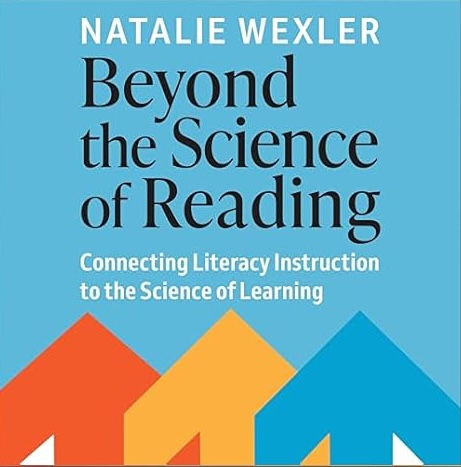
There is something almost combustible about stepping into the reading debate right now. Say “science of reading” in a room of educators and you can feel the temperature shift. For some, it represents long-overdue clarity—systematic phonics, structured literacy, fidelity to research. For others, it signals narrowing, mandates, and a fear that reading will be reduced to drills and decodables, wondering if we read to understand. Into this landscape, Natalie Wexler offers Beyond the Science of Reading: Connecting Literacy Instruction to the Science of Learning, and instead of choosing a side, she reframes the question.
Wexler does not dispute the importance of phonics. In fact, she acknowledges the significant policy shifts since 2019 that have pushed states to align early literacy with evidence on decoding. But she argues that we have misunderstood the scope of the problem. America’s reading crisis, she suggests, is not simply a decoding crisis. It is a learning crisis. Comprehension is not a transferable skill we can practice in isolation. It depends heavily on knowledge stored in long-term memory. Without that knowledge, strategy instruction becomes performative students can “find the main idea” on a worksheet yet struggle to understand a complex text about history, science, or civic life.
That distinction matters, especially in the current U.S. context where much of the conversation has centered on foundational skills. Wexler argues that while systematic phonics is necessary, it is insufficient. Many schools have treated comprehension as a set of abstract strategies—predicting, questioning, visualizing—rather than as the natural outgrowth of accumulated knowledge. The result has been stagnant achievement and persistent gaps, particularly for students who rely most on schools to build background knowledge coherently over time.
What makes this book especially compelling is how it situates literacy within the broader science of learning. Wexler draws on research about memory, cognitive load, retrieval practice, and writing to argue that reading instruction should be inseparable from what we know about how humans actually learn. Knowledge does not accumulate randomly. It requires intentional sequencing, cumulative review, and opportunities to retrieve and apply information. Writing, she argues, is not an add-on but a powerful mechanism for strengthening understanding. In this way, the book moves beyond the reading wars and toward something more integrative: literacy as part of a coherent instructional system grounded in cognitive science.
Equity runs quietly but forcefully through her argument. Students from knowledge-rich environments often acquire background information incidentally. Others depend on school to provide that structure. When curricula fragment into disconnected units or prioritize skills over substance, it is those students who are most disadvantaged. Explicit, content-rich instruction is not about rigidity or indoctrination, as critics sometimes suggest. It is about access—about ensuring that all students have the cognitive tools necessary to engage with complex text and ideas.
What I appreciate most about Wexler’s approach is its refusal to collapse into slogans. She does not romanticize knowledge, nor does she dismiss the importance of engagement and joy. Instead, she asks a more demanding question: if comprehension depends on stored knowledge, and learning depends on how memory works, then how should we design literacy instruction differently? That question extends beyond phonics mandates or curriculum purchases. It touches teacher preparation, assessment practices, and the long arc of content coherence.
In a moment when debates about reading often feel polarized and reactive, Beyond the Science of Reading invites intellectual humility. It challenges us to expand our definition of evidence-based literacy so that it encompasses not just how children learn to decode, but how they learn—period. Decoding may open the door to literacy, but it is knowledge, deliberately built and revisited, that allows students to walk through it with confidence and understanding.