Motivation is one of the holy grails of education, fitness, work, and productivity. Students of education know that nearly everything depends on this essential driving force of learning. Teachers constantly struggle to cultivate motivation in their students, while many of us notice perceived shortcomings in ourselves and others whenever willpower seems to falter, often to the point of frustration and harsh self-deprecation. It becomes remarkably easy to conclude that what we or others lack is motivation itself—we lack will power. We begin to see motivation as a personal trait, almost a fixed characteristic—a sign of virtue—rather than something dynamic and deeply shaped by context.
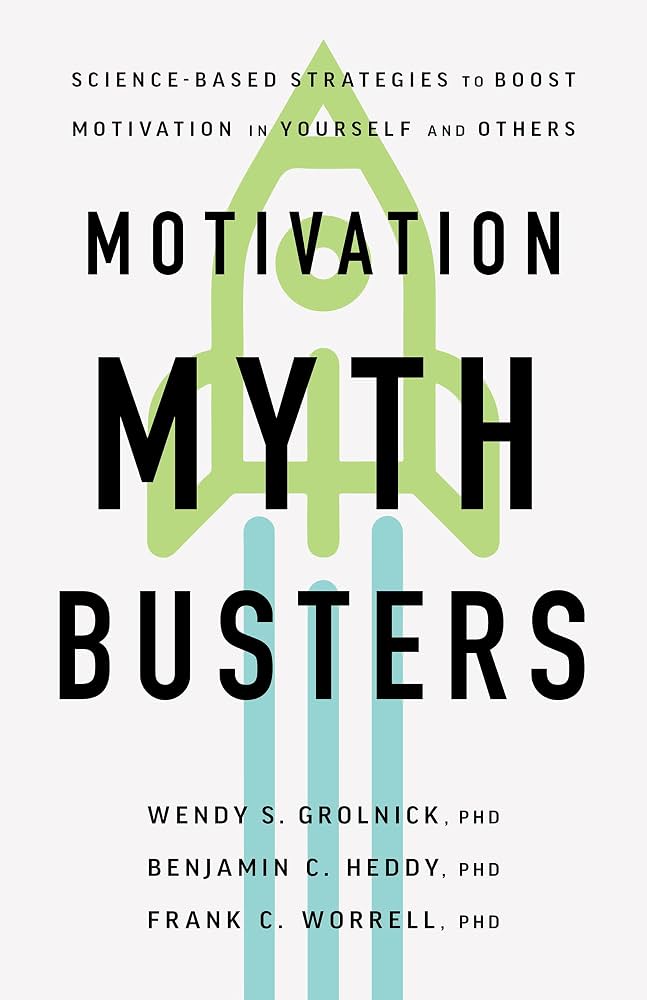
That assumption is what Motivation Myth Busters by Wendy Grolnick, Benjamin Heddy, and Frank Worrell challenges so effectively. Rather than offering yet another collection of productivity hacks or motivational clichés, the authors carefully dismantle some of the most pervasive cultural myths surrounding motivation and replace them with a far more nuanced, evidence-based understanding rooted in psychological science. In doing so, they invite readers to rethink not only how we motivate ourselves, but also how we attempt to motivate students, children, colleagues, and those we care about.
What makes this book particularly compelling is its resistance to simplistic thinking. Motivation is often discussed in binaries: you either have it or you don’t; rewards either work or they don’t; competition either drives excellence or causes harm. The authors resist these easy narratives. Instead, they repeatedly show that motivation is far more complex, emerging from the dynamic interplay between personal values, perceived competence, autonomy, relationships, and environmental conditions.
One of the book’s most important contributions is its challenge to the common belief that some people are simply motivated while others are not. This myth feels intuitive because we so often commit what psychologists call the fundamental attribution error—we interpret others’ behavior as a reflection of character while explaining our own behavior through circumstance. A disengaged student becomes “lazy.” An employee who appears indifferent is labeled “unmotivated.” Yet the deeper insight offered here is that people are rarely devoid of motivation altogether; rather, they are often highly motivated toward things that others fail to recognize or value. The issue is not usually the absence of motivational energy, but the direction in which that energy is being expressed.
This shift in perspective has profound implications. Once we stop asking, “How do I make this person motivated?” and instead begin asking, “What conditions are helping or hindering motivation?” our entire approach changes. The focus moves away from control and toward understanding.
The authors draw heavily from Self-Determination Theory, expectancy-value theory, self-efficacy research, personal interest development, and attribution theory, but they do so with impressive accessibility. Readers unfamiliar with motivation science will find the material approachable, while those already familiar with the literature will appreciate the thoughtful synthesis. Particularly influential throughout the book is the framework of self-determination theory, which suggests that human motivation flourishes when three psychological needs are supported: autonomy, competence, and relatedness. This triad appears repeatedly, not as an abstract model, but as a practical lens for understanding human behavior.
What struck me most while reading was how often our well-intended attempts to motivate others can inadvertently undermine motivation. Rewards, praise, pressure, and competition are cultural defaults. We reach for them instinctively because they often produce visible short-term results. A child completes chores for a reward. A student studies to earn points. An employee performs for a bonus. But as the authors repeatedly show, compliance and motivation are not synonymous. External rewards can create movement, but they do not necessarily cultivate commitment. In fact, they can sometimes weaken intrinsic motivation by shifting attention away from meaning and toward external payoff.
As an educator, this theme resonated deeply. How often do we mistake visible engagement for genuine learning? How often do we confuse performance with understanding? The chapter on praise was especially thought-provoking. Telling someone they are smart or talented feels supportive, yet the research suggests such praise can create fragile identities. If success becomes proof of intelligence, failure can begin to feel like evidence of inadequacy. In that framework, mistakes become threatening rather than informative.
The authors avoid replacing old myths with new dogmas. The authors do not argue that rewards are always harmful or that competition is universally destructive. Rather, they consistently emphasize nuance. Competition can motivate under certain conditions. Rewards can be useful when thoughtfully applied. Visualization can help, but only when paired with planning and self-regulation. Structure, often assumed to limit autonomy, can actually enhance motivation when it provides clarity, predictability, and a pathway toward competence.
This balanced perspective is one of the book’s greatest strengths because motivation itself is inherently complex. It exists at the intersection of cognition, emotion, identity, culture, opportunity, and meaning. That complexity helps explain why simplistic advice so often falls short.
In many ways, Motivation Myth Busters serves as an antidote to our culture’s obsession with discipline, grit, and optimization. It reminds us that motivation is not something we forcibly inject into ourselves or others through sheer will or clever incentives. Rather, motivation emerges when the right psychological and environmental conditions are present.
Perhaps the most meaningful lesson of the book is also the most human: instead of trying to light a fire under people, we may be better served by asking what is already burning within them and what barriers are preventing that energy from being directed toward growth. That shift—from control to curiosity—feels subtle at first, but it may ultimately change everything.