Educators have long rejected the idea of a Brave New World version of schooling—students programmed, standardized, and engineered for compliance. We resist the image of children treated like interchangeable parts in a system optimized for efficiency. And yet, despite that resistance, we often participate in a quieter version of the same logic. We design instruction, interventions, and reforms around what works for the average student, even while knowing—both from research and from daily experience—that no such student actually exists.
This tension sits at the heart of Yong Zhao’s Fix the Past or Invent the Future.
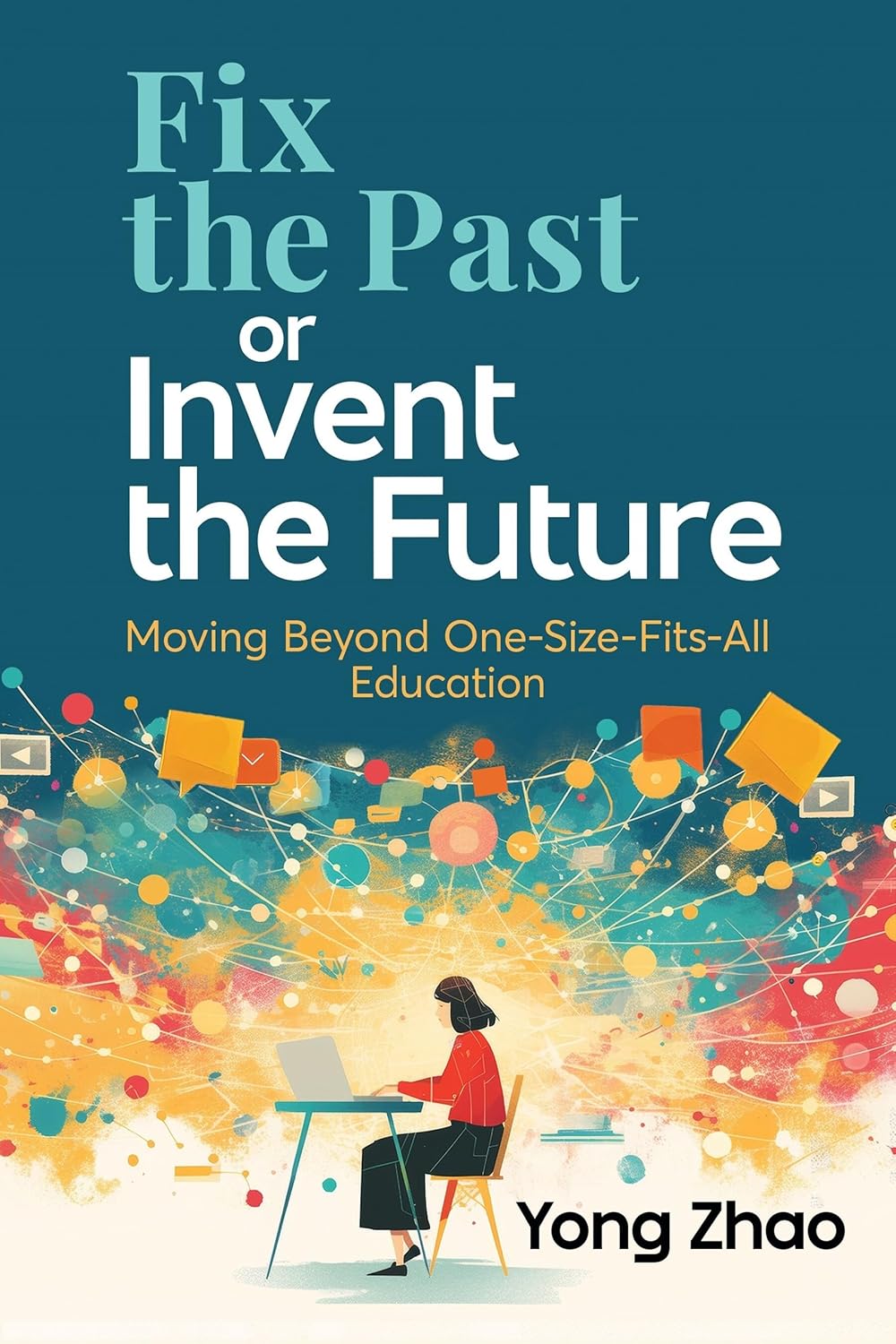
Zhao’s argument is not that research is misguided or that we should abandon what large-scale studies have taught us. It’s more unsettling than that. He asks us to notice how easily conclusions about groups slip into prescriptions for individuals—and how rarely we pause to consider the consequences. The book is a sustained critique of one-size-fits-all thinking, even when it arrives under the banner of “evidence-based practice.”
The first half of the book takes aim at familiar reform tools: effect sizes, randomized controlled trials, growth mindset, SEL, and even the current enthusiasm for AI. Zhao’s critique is careful. These approaches can be useful. The problem arises when probability is mistaken for certainty.
Effect sizes, Zhao reminds us, describe likelihoods across populations. They do not tell us what will work for a particular student in a particular classroom. A practice can show a positive average effect while leaving some students unchanged—or worse, less engaged and less confident. In fields like medicine, this limitation is taken seriously. Benefits are weighed against potential side effects. In education, those side effects are rarely discussed at all.
We celebrate the mean and overlook the margins.
This overreliance on averages helps explain why decades of reform have produced so little lasting improvement. Programs are scaled up because they “work,” implemented with fidelity, and applied broadly. When students struggle, the response is often more intensity rather than more discernment. More effort. More grit. More persistence.
He does not argue against effort. He argues against the assumption that effort is always the right response. Persistence without direction can become a liability. Students may be encouraged to double down on paths that don’t align with their interests, strengths, or long-term development. Zhao introduces what he calls a meta-growth mindset: the capacity to decide where effort belongs. Sometimes growth means persisting. Sometimes it means redirecting—or stopping altogether.
His discussion of AI follows a similar logic. Zhao is not warning about machines replacing teachers or students outsourcing thinking. His concern is that AI, when embedded in the traditional grammar of schooling, becomes constrained by it. If what students are required to learn remains fixed and prescribed, AI will mostly be used to do old things more efficiently. The real potential of AI, Zhao argues, lies in supporting personalization—helping students find, frame, and pursue meaningful problems in ways that reflect who they are.
The second half of the book turns toward what it would mean to invent the future rather than fix the past. True personalization, Zhao insists, cannot be done for students. It has to be done by them. That requires loosening our grip on prescribed curricula, rethinking assessment, and reframing the role of teachers—not as deliverers of content, but as designers, mentors, and partners.
Learning, in this vision, shifts from solving prepackaged problems to finding new ones. From individual competition to human interdependence. From compliance to contribution. Global competence is not a program to be added on, but an outcome of learning that is connected to real people and real needs.
Fix the Past or Invent the Future does not offer a checklist or a quick fix. Each learner arrives with a jagged profile—uneven strengths, uneven interests, uneven trajectories.
Zhao writes the way many educators think—clearly, directly, and with an eye on real classrooms rather than abstract debates. He moves comfortably between research, lived experience, and concrete examples, which makes even his sharper critiques feel inviting rather than combative. The chapters are easy to follow without feeling formulaic, and his tone encourages readers to pause, reflect, and occasionally push back. It’s a readable, engaging book that respects the reader’s intelligence without demanding unnecessary technical endurance.
The question Zhao leaves us with is not whether our reforms are supported by evidence, but whether we are paying attention to the students in front of us—or merely to the data that describes them from a distance.