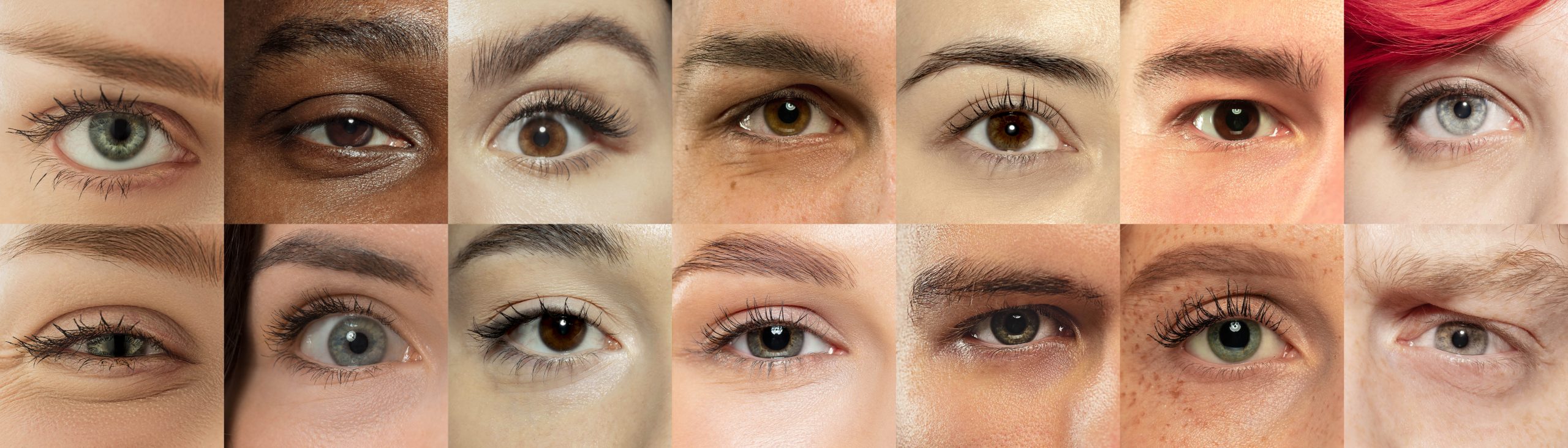
Let’s start with a seemingly straightforward logical chain:
- To learn in school, students need to pay attention.
- But: how do teachers know IF they’re paying attention?
- Well: most of the time, most people are paying attention to the person or object they’re looking at.
- So, teachers should explicitly direct students’ gaze.
- If students are looking at the teacher–or the book, or another student who’s answering a question–they’re probably paying attention. If they’re paying attention, they’re likelier to learn.
This simple summary requires a few caveats.
First: different cultures have different norms around eye contact.
Second: some people find eye contact intensely more difficult than others do. Students on the spectrum–for example–can find eyeball-to-eyeball focus overwhelming.
In both these cases, we can and should make reasonable exceptions to any “you have to look at me right now” policy.
At the same time, many (many!) pedagogical approaches require students to look at a person, passage, slide, or screen. For what it’s worth, I myself think that’s an entirely reasonable expectation (with the caveats noted above).
But, WAIT JUST A MINUTE. What if eye contact interferes with thinking?
Intriguing Data
A study done in Japan back in 2016 raises this alarming possibility.
Researchers gave adults a kind of verbal completion task. Each participant heard a long list of nouns: for instance, “milk.” After each one, they had to respond with an appropriate verb: say, “drink.”
In some cases, the noun/verb pair is so simple as to require little thought. The “milk/drink” duo is a low-challenge task. In other cases, the mental load went up. Some nouns imply many possible verbs. The noun “soup” invites either “make” or “eat” or “drink.”
Even more challenging, participants sometimes chose obscure verbs. When hearing the noun “list,” most people responded with the verb “make.” Others offered the verb “be on”: a choice that’s plausible but rare–and implies greater cognitive work.
Crucially, the researchers measured how long the participants took to generate those verbs. They assumed–reasonably–that slower verb generation implied heavier cognitive lifting.
Where does the eye contact come in? An excellent question.
While the participants did this noun/verb work, they watched videos of faces. In fact, they were specifically instructed to look at the faces in those videos.
- Half of the time, those faces were looking directly at the camera; in other words, making direct eye contact with the viewer.
- And half of the time, those faces were looking off to the side.
So here’s the question: did the eye-contact video have an effect on the cognitive work required to generate verbs?
Results and Implications
Sometimes, yes.
That is: the participants needed extra time to generate verbs if
a) they came up with the most challenging verbs,
AND
b) they made eye contact with the camera-facing faces.
In brief: if thinking is already challenging, adding eye contact makes thinking even MORE difficult.
I have found this study fascinating, and it’s made me reconsider my own expectations for classroom eye contact. I do typically expect my students to look at me (or the board or the book or the classmate), and I do occasionally cue them to do so.
This study makes me open to a few potential exceptions.
- If I have asked students a difficult question, the additional demand for eye contact might complicate their thought processes.
- If a student is developing a particularly sophisticated answer or question, s/he might need some cognitive headroom…and therefore the freedom to look away.
Eye contact helps students focus outward; looking away seems to help them focus inward. Both have their place in learning.
As Always, Caveats
I should be clear about the limitations of my argument.
First: this eye-contact study doesn’t make any claims at all about classroom teaching. I’m extrapolating, combining this study with my own experience.
Second: each classroom and school will have its own dynamics. The culture and pedagogy of your school, and the age and neuro-profile of your students will shape your application of this broad principle.
Third: because norms around eye-contact vary among cultures, I should emphasize that the original research was done in Japan. (As far as I can tell, this study hasn’t been replicated.) In fact, about 1/5th of the participants in the study dropped out because they couldn’t maintain base-level eye contact. Application of this research finding to other cultural contexts requires close awareness to this cultural framework.
With those cautions noted, I myself arrive at this pair of conclusions:
- In most cases, teachers can and should focus students’ attention by deliberately focusing their gaze.
- When students need to THINK HARD, they may need to break eye contact to gather their thoughts more effectively.
A bit poetically, I might put it this way: when they’re thinking deeply, I can let my students stop focusing outward so that they can focus intensely inward. Deeper thought, it seems, benefits from such inward gaze.
Kajimura, S., & Nomura, M. (2016). When we cannot speak: Eye contact disrupts resources available to cognitive control processes during verb generation. Cognition, 157, 352-357.