emotions – Education & Teacher Conferences Skip to main content
Shift: Managing Your Emotions—So They Don’t Manage You by Ethan Kross
Erik Jahner, PhD
Erik Jahner, PhD

Emotions move quickly—often faster than our awareness of them.

In my work studying and teaching about emotions, and increasingly in my training as a therapist, I’ve become fascinated by how rapidly emotional reactions unfold. A moment of confusion turns into irritation. Irritation becomes anger. Sometimes that anger quietly flips inward into self-criticism before we even realize what happened. I see this with teachers, students, parents, and couples alike. The emotional trajectory can escalate astonishingly fast.

One of the most important skills I’ve seen emerging across therapy, education, and personal development is deceptively simple: slowing the emotional process down enough to notice it—creating a window into the process and gently nudging its trajectory.

That is the terrain Ethan Kross explores in Shift: Managing Your Emotions—So They Don’t Manage You. Rather than treating emotions as problems to suppress or eliminate, Kross argues that they are tools for navigating the world. Fear sharpens awareness of danger, anger can mobilize us to confront threats or injustices, and regret helps us avoid repeating mistakes. The difficulty begins when emotions become too intense or persist longer than they are useful—when they start steering our behavior on autopilot rather than informing it.

Kross’s central idea is that emotional experiences have trajectories, and that we possess tools that can redirect them. He calls these tools emotional shifters. Some operate internally—through attention, perspective, or sensory experiences. Others operate externally through our environments, relationships, and cultural contexts. The point is not to master one technique but to understand that emotional regulation is flexible. Different situations require different tools, much like a mechanic choosing the right instrument for a particular problem.

Structurally, the book moves through several layers of this system. Kross begins by asking a deceptively simple question: why do we feel emotions at all? From there he introduces internal “shifters,” followed by external ones, before turning to the challenge of making these strategies habitual in everyday life. Along the way he blends psychological research, neuroscience findings, and vivid stories—from Navy SEAL training to his own family history—to illustrate how emotional regulation plays out in real situations. The result is a book that sits comfortably between popular psychology and applied emotional science: accessible without losing its grounding in research.

What makes the book especially relevant for researchers and educators is its developmental lens. Emotional regulation is not simply a matter of well-being; it is deeply connected to long-term life outcomes. Research discussed in the book suggests that individuals who develop stronger emotion-regulation capacities tend to fare better across domains including education, health, relationships, and economic stability. Importantly, these capacities are malleable, meaning they can be strengthened over time.

That insight resonates strongly with work in psychology and education. We often treat emotions as background conditions for learning—as something to manage elsewhere so cognition can begin. But Shift suggests something more integrated. Emotions are not separate from attention, persistence, conflict resolution, or motivation. They are braided through them.

In my own experience working with students and clients, the first step in changing emotional patterns is rarely eliminating the feeling itself. Instead, it begins with noticing—learning to recognize emotional signals in the body and mind early enough to intervene. When people can pause long enough to interpret what they are feeling, they gain the opportunity to redirect the emotional process before it spirals into conflict, avoidance, or self-attack.

Shift is written primarily for a general audience, but it will resonate strongly with psychologists, educators, therapists, and anyone interested in how emotional regulation unfolds in real life. The storytelling, clear writing, and thoughtful structure make it a book that works equally well for relaxed reading and deeper learning.

In a culture that often rewards speed over reflection, Kross’s message is a subtle but powerful one: the ability to understand and gently redirect our emotions may be one of the most important skills we can develop—for learning, for relationships, and for developing a stronger relationship with ourselves.

Shift is less about controlling emotions than about developing a more thoughtful relationship with them.


Goals, Failure, and Emotions: a Conceptual Framework
Andrew Watson
Andrew Watson

Researchers can provide guidance to teachers by looking at specific teaching practices.

In last week’s post, for instance, I looked at a study about learning from mistakes. TL;DR: students learned more from review sessions where they explored their own mistakes than those where teachers reviewed ideas.

Or,

Back in December, I looked at a study about using “pre-questions” to reduce mind-wandering. Sure enough, students who answered pre-questions about a topic spent less time mind-wandering than those who didn’t.

Obviously, these studies might provide us with lots of useful guidance.

At the same time, this “one-study-at-a-time” approach has its drawbacks. For instance:

What if my students (or class) don’t really resemble the students (or class) in the study?

What if THIS study says that pre-questions reduce mind-wandering, but THAT study says they don’t?

What if THIS study (again) says that pre-questions reduce mind wandering, but THAT study says that mindful meditation reduces mind-wandering? Which strategy should I use?

And so forth.

Because of these complexities, we can — and should — rely on researchers in another way. In addition to all that research, they might also provide conceptual frameworks that help us think through a teaching situation.

These conceptual frameworks don’t necessarily say “do this.” Instead, they say “consider these factors as you decide what to do.”

Because such guidance is both less specific and more flexible, it might be either especially frustrating or especially useful.

Here’s a recent example…

Setting Goals, and Failing…

We spend a lot of time — I mean, a LOT of time — talking about the benefits of short-term failure. Whether the focus is “desirable difficulty” or “productive struggle” or “a culture of error,” we talk as if failure were the best idea since banning smoking on airplanes.

Of course, ask any student about “failure” and you’ll get a different answer. Heck: they might prefer smoking on airplanes.

After all: failure feels really unpleasent — neither desirable nor productive, nor cultured.

In a recent paper, scholars Ryan Carlson and Ayelet Fishbach explore the complexity of “learning from failure”: specifically, how failure interefers with students’ goals.

To create a conceptual framework around this question, Carlson and Fishbach create two concept pairs.

First: they consider the important distinction between goal setting and goal striving.

Happily, those terms mean just what they say.

When I decide that I want to learn Spanish, or strengthen my friendships, or stop drinking caffein, I am setting a goal.

When I decide to enroll in a Spanish class, schedule more frequent dinners with pals, or purge my kitchen of all my coffee clutter, now I’m goal striving.

This pair helps us think through the big category “goals” in smaller steps.

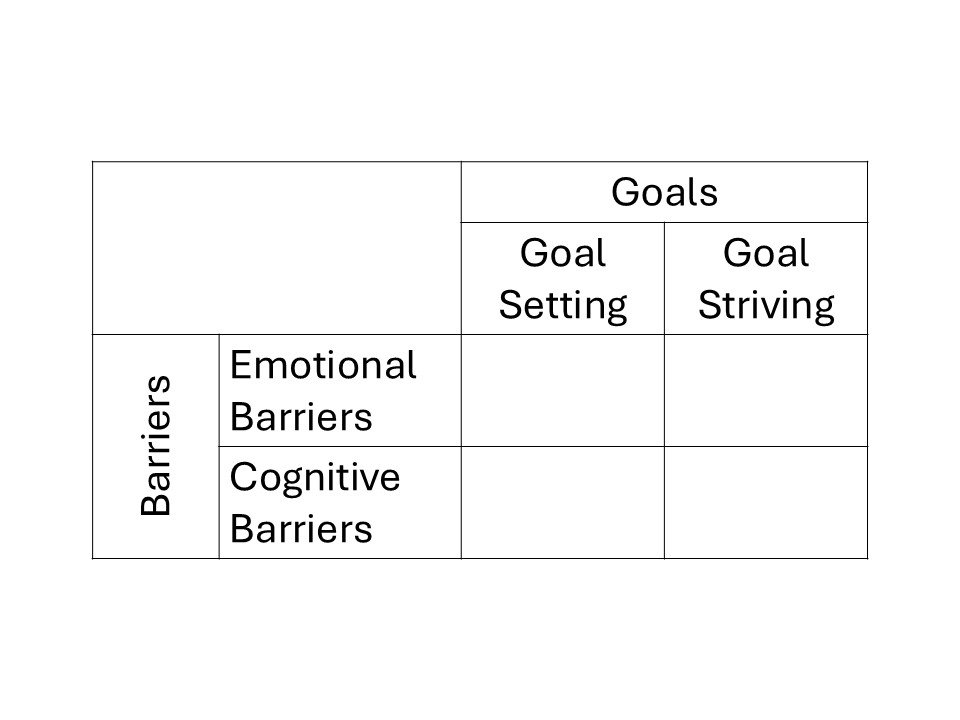
Second: Carlson and Fishbach consider that both emotional barriers and cognitive barriers can interfere with goal setting and goal striving.

The resulting conceptual possibilities look like this:

A 2x2 grid: with "goal setting" and "goal striving" as two columens, and "emotional barriers" and "cognitive barriers" as two rows.

The grid created by these conceptual pairs allows us to THINK differently about failure: both about the problems that students face, and the solutions that we might use to address them.

Troubling Examples

Having proposed this grid, Carlson and Fishbach explore research into its four quadrants. I’ll be honest, resulting research and insights frequently alarmed me.

For instance, let’s look at the top-left quadrant: “emotional barriers during goal setting.”

Imagine that one of my students contemplates an upcoming capstone project. She wants to set an ambitious goal, but fears that this ambitious target will lead to failure.

Her emotional response during  goal setting might prompt her to settle for an easier project instead.

In this case, her emotional response shuts down her thinking before it even started. As Carlson and Fishbach pithily summarize this situation: “people do not need to fail for failure to undermine learning.”

YIKES. (Suddenly, the whole “desirable difficulties” project sounds much less plausible…)

Or, top right (emotional barriers/goal striving): it turns out that “information avoidance” is a thing.

People often don’t want to learn results of medical tests — their emotions keep them from getting to work solving a potential health problem.

So, too, I can tell you from painful experience that students often don’t read the comments on their papers. When they’re disappointed with a grade, they don’t consistently react by considering the very feedback that would help them improve — that is, “strive to meet the goal of higher grades.”

Or, lower right (cognitive barriers/goal striving). Carlson and Fishbach describe a study — intriguingly called “The Mystery Box Game.”

Long-story short: in this game, learning how to fail is more beneficial than learning about one path to success. Yet about 1/3 of participants regularly choose the less beneficial path — presumably because “learning how to fail” feels too alarming.

Problems Beget Solutions?

So far, this blog post might feel rather glum: so much focus on failure!

Yet Carlson and Fishbach conclude their essay by contemplating solutions. Specifically, they use a version of that grid above to consider solutions to the cognitive and emotional barriers during goal setting and goal striving.

For example:

  • “Vicarious learning”: people learn more from negative feedback when it’s directed at someone else.
  • “Giving advice”: counter-intuitively, people who give advice benefit from it at least as much as those who receive it. So, students struggling with the phases above (say: cognitive barriers during goal striving) might be asked for advice on how to help another student in a similar situation. The advice they give will help them.
  • “Counter-factual thinking”: students who ask “what if” questions (“what if I had studied with a partner? what if I had done more practice problems”) bounce back from negative feedback more quickly and process it more productively.

Because I’ve only recently come across this article, I’m still pondering its helpfulness in  thinking about all these questions.

Given the optimism of “desirable difficulty/productive struggle” in our Learning and the Brain conversations, I think it offers a helpful balance to understand and manage these extra levels of realism.


Carlson, R. W., & Fishbach, A. (2024). Learning from failure. Motivation Science.

Hope for Cynics by Jamil Zaki
Erik Jahner, PhD
Erik Jahner, PhD

cynicsWhen I first picked up Hope for Cynics: The Surprising Science of Human Goodness by Jamil Zaki, I thought, “I’m a hopeful person—why would I want to read about how to not be a cynic?” But as I made my way through the early pages, I realized cynicism had quietly become normalized in my life, and I had missed the signs. It had been parasitically pulling my hope away. Maybe it was the political turbulence of recent years, natural disasters, or the perceived decline of intellectual value, but noticed I was infected with cynicism by a thousand little cuts, unaware of the changes around me.

Reading this book was a revelation. I was surprised to discover areas of myself I didn’t even know needed to find hope again. I was surprised by the personal elevation of cynicism I had begun to imbibe from my culture. Zaki’s insights gave me a renewed sense of self and opened my eyes to the warning signs of creeping cynicism. The book helped me begin a journey back to hope and trust. Like many, I had confused cynicism with skepticism. As Zaki points out, cynicism is a lack of faith in people, while skepticism is a lack of faith in assumptions. Through stories of admiration for a close friend, Zaki found the power of “hopeful skepticism”—a blend of curiosity and love for humanity.

Jamil Zaki challenges the belief that cynicism is a mark of wisdom. Instead, he reveals it as a reaction to disappointment that ultimately harms our mental health, relationships, and society. The book explores the surprising science behind human goodness, offering evidence that people are far more cooperative and honest than we’re led to believe. Zaki shares how our negativity bias and the media’s focus on bad news distort our worldview, leaving us to think the worst of humanity.

Through his artful blend of science and personal storytelling you will empathize with his protagonists and have your curiosity and sense of exploration expanded. Zaki’s research is fascinating, but it’s his honesty and warmth that make it truly memorable. He weaves in stories of friends, historical figures, and his own life, crafting a narrative that feels both intimate and universal. His reflections on how cynicism has affected him—and how hope has transformed him—are deeply relatable.

Zaki doesn’t stop at diagnosing the problem; he provides practical strategies for change. From practicing gratitude to building stronger relationships, his advice is both research-based and actionable. One of the most impactful lessons for me was learning to appreciate the cynics in my life. I realized I could love them more deeply by understanding where their cynicism came from and recognizing their potential for growth, just as I saw in myself.

By the time I finished Hope for Cynics, I felt reinvigorated. Zaki’s hopeful message reminded me that cynicism isn’t inevitable—it’s a habit we can unlearn. While the tips are thoughtfully collected in the appendix for rapid reminders and exercises, this book isn’t just a collection of tips or research findings; it’s a deeply emotional, thought-provoking journey that will leave you questioning your assumptions and embracing the possibility of human goodness.

Hope for Cynics is an invaluable read for teachers, administrators, students, and anyone looking to foster a more positive and productive environment. The book offers practical strategies for overcoming cynicism, which can be especially beneficial in educational settings where trust, empathy, and collaboration are essential. Teachers and administrators can use the insights to build stronger relationships with students and colleagues, promote a more hopeful and inclusive atmosphere, and counteract the negativity often prevalent in modern discourse. Students, too, will find the book inspiring, as it encourages a shift toward a more balanced, optimistic view of human nature, which can enhance their emotional well-being and academic success. By applying Zaki’s insights, individuals in education can create more trusting, resilient communities.

Whether you’re struggling with cynicism yourself or simply looking for ways to foster a more hopeful outlook, this book offers a roadmap to a richer, more connected life. It’s the kind of book you’ll return to for inspiration and guidance—a heartfelt, empowering read that deserves a spot on everyone’s shelf.