Can AI teach creativity?
This question feels oddly self-contradictory. Creativity feels like the most human of human characteristics — how could a chatbot teach it? A recent study put that assumption to the test, and arrives at helpfully provocative conclusions.
Here’s the story:
How Many Ways Can You Use an Umbrella?
“Creativity” poses a fascinating research challenge. On the one hand, everyone champions the development of creative thinkers. On the other hand, how can we research creativity itself? We’ll need a way to measure creativity — and that task feels quite daunting. Is Georgia O’Keeffe more creative than Toni Morrison? Is this student’s computer program more creative than that student’s sonnet?
To measure creativity, scholars often rely on the “Alternative Uses Test”: the AUT. In this test, I give you an everyday object – say, a brick. You have three minutes to tell me all the alternative uses you might have for that brick. You could use it to prop open a door, shore up a bookshelf, or grind it up in water and use it as a pigment for your painting.
The AUT is typically scored on three dimensions:
- The number of ideas (“fluency”)
- The uniqueness of those ideas (“originality”)
- The number of different categories of ideas (“flexibility”)
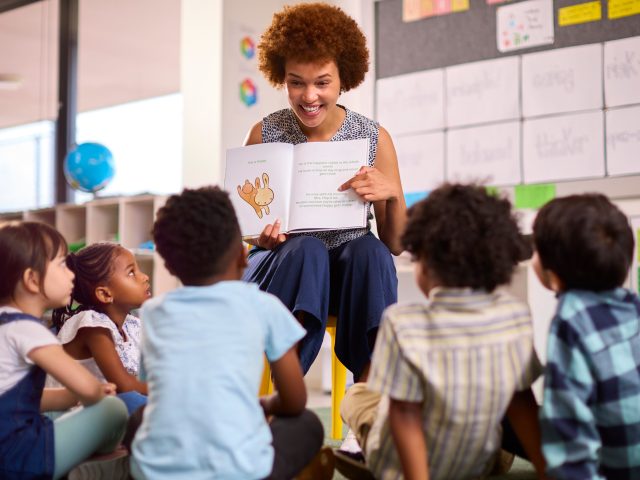
For this study, researchers in Shanghai invited students to their lab. The students took an AUT pretest: “list as many uses as you can for a book.” They then had a ten minute lesson in creative thinking — specifically “divergent thinking, association, and decomposition.” Some students worked one-on-one with a human tutor; other students worked one-on-one with ChatGPT 4.0. (To be thorough, another batch of students sat quietly for ten minutes: no creativity tutoring for them.)
After all this training, the researchers gathered more data.
- First, the students took a follow-up AUT; they generated uses for an umbrella and a can.
- Second, the students rated their human and AI tutors on the quality of the emotional connection and the quality of the interaction.
- Third, they looked at brain scan data.
What did they learn?
Surprising, or Not?
I’m not surprised to learn that the participants rated humans more highly than the AI tutors on “emotional connection” and “quality of interaction.” (I myself would be puzzled to discover that people are — on average — more emotionally connected to a chatbot than to a person.)
I’m also not surprised to learn that these tutoring sessions correlate with activity in different brain regions. While I suspect the popular press will make a big deal about this point (“AI actually activates DIFFERENT PARTS OF THE BRAIN!”), the finding is entirely predictable. If participants felt more connected to other humans than to the chatbot, then of course brain regions are activating differently. My brain activates differently when listening to a symphony than when watching a dance recital, and yours does too.
I AM surprised to learn that students improved somewhat more on the AUT test when working with chatbots than when working with people. (The precise numbers get too complicated to be worth reporting: “somewhat more” is probably the best way to describe this result.)
This finding might be reported with a flashy headline: “AI teaches creativity better than humans!”
I think that’s not a fair statement, for two reasons.
First: researchers found gains immediately after the tutoring session. But they didn’t remeasure a week later, or even an hour later. We have no way to know whether or not those differences lasted. In fact, we see over and over that short-term gains in performance do not result in long-term learning. Until researchers run studies with long-term retests, we shouldn’t make confident claims.
Second: the AUT is a researcher-friendly way to measure specific aspects of creativity, but that doesn’t mean that it measured actual human creativity. Will the students who got AI tutoring compose better symphonies, write richer poems, or code cleverer computer programs than their human-tutored peers? We just don’t know.
Two Take-Aways
For these reasons, I do NOT conclude that schools should hand over creative writing classes to AI chatbots. Instead, I come away with two conclusions.
A. Chatbots can succeed at surprisingly human tasks. Yes, the AUT is an imperfect and narrow measure. But in this case, AI helped students improve at this kind of creative thinking — at least in the short term. I should be more open to the possibility that AI can help us learn in surprising ways.
B. AI research — even more than most other research topics I know — leads to complicated conclusions: conclusions that must be stated narrowly and precisely.
For instance, over a year ago I described an AI study with just such a complex conclusion.
- An AI chatbot was BETTER than humans at tutoring students as they practiced math…
- BUT only in the short-term. In the long term, students remembered more without the AI tutor…
- UNLESS they used a special AI tutor, programmed to provide hints, not give answers. In this case, students did equally well in the long term with and without the AI tutor.
Like the creativity study described above, this math-tutoring study can be easily mischaracterized: “students learn less with AI math tutors!” The reality was substantially more nuanced.
In Sum
AI is going to be part of many classrooms; that much is clear. Studies like this one help us see both its promise and its limits. Yes, a chatbot can boost certain kinds of creative output in the short term. But creativity in school — and in life — depends on more than generating ideas on demand. If we’re thoughtful about how we use these tools, they may support learning. If we’re not, they may simply make thinking easier without making students better thinkers.
Jin, Z., Yin, J., Tian, Q., Zhou, X., Li, Y., Yang, T., & Luo, J. (2026). Can Large Language Models Teach Creativity? Cognitive Gains, Affective Gaps, and Distinct Neural Patterns. Computers in Human Behavior: Artificial Humans, 100288.