Emotions move quickly—often faster than our awareness of them.
In my work studying and teaching about emotions, and increasingly in my training as a therapist, I’ve become fascinated by how rapidly emotional reactions unfold. A moment of confusion turns into irritation. Irritation becomes anger. Sometimes that anger quietly flips inward into self-criticism before we even realize what happened. I see this with teachers, students, parents, and couples alike. The emotional trajectory can escalate astonishingly fast.
One of the most important skills I’ve seen emerging across therapy, education, and personal development is deceptively simple: slowing the emotional process down enough to notice it—creating a window into the process and gently nudging its trajectory.
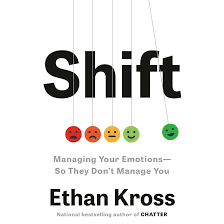
That is the terrain Ethan Kross explores in Shift: Managing Your Emotions—So They Don’t Manage You. Rather than treating emotions as problems to suppress or eliminate, Kross argues that they are tools for navigating the world. Fear sharpens awareness of danger, anger can mobilize us to confront threats or injustices, and regret helps us avoid repeating mistakes. The difficulty begins when emotions become too intense or persist longer than they are useful—when they start steering our behavior on autopilot rather than informing it.
Kross’s central idea is that emotional experiences have trajectories, and that we possess tools that can redirect them. He calls these tools emotional shifters. Some operate internally—through attention, perspective, or sensory experiences. Others operate externally through our environments, relationships, and cultural contexts. The point is not to master one technique but to understand that emotional regulation is flexible. Different situations require different tools, much like a mechanic choosing the right instrument for a particular problem.
Structurally, the book moves through several layers of this system. Kross begins by asking a deceptively simple question: why do we feel emotions at all? From there he introduces internal “shifters,” followed by external ones, before turning to the challenge of making these strategies habitual in everyday life. Along the way he blends psychological research, neuroscience findings, and vivid stories—from Navy SEAL training to his own family history—to illustrate how emotional regulation plays out in real situations. The result is a book that sits comfortably between popular psychology and applied emotional science: accessible without losing its grounding in research.
What makes the book especially relevant for researchers and educators is its developmental lens. Emotional regulation is not simply a matter of well-being; it is deeply connected to long-term life outcomes. Research discussed in the book suggests that individuals who develop stronger emotion-regulation capacities tend to fare better across domains including education, health, relationships, and economic stability. Importantly, these capacities are malleable, meaning they can be strengthened over time.
That insight resonates strongly with work in psychology and education. We often treat emotions as background conditions for learning—as something to manage elsewhere so cognition can begin. But Shift suggests something more integrated. Emotions are not separate from attention, persistence, conflict resolution, or motivation. They are braided through them.
In my own experience working with students and clients, the first step in changing emotional patterns is rarely eliminating the feeling itself. Instead, it begins with noticing—learning to recognize emotional signals in the body and mind early enough to intervene. When people can pause long enough to interpret what they are feeling, they gain the opportunity to redirect the emotional process before it spirals into conflict, avoidance, or self-attack.
Shift is written primarily for a general audience, but it will resonate strongly with psychologists, educators, therapists, and anyone interested in how emotional regulation unfolds in real life. The storytelling, clear writing, and thoughtful structure make it a book that works equally well for relaxed reading and deeper learning.
In a culture that often rewards speed over reflection, Kross’s message is a subtle but powerful one: the ability to understand and gently redirect our emotions may be one of the most important skills we can develop—for learning, for relationships, and for developing a stronger relationship with ourselves.
Shift is less about controlling emotions than about developing a more thoughtful relationship with them.